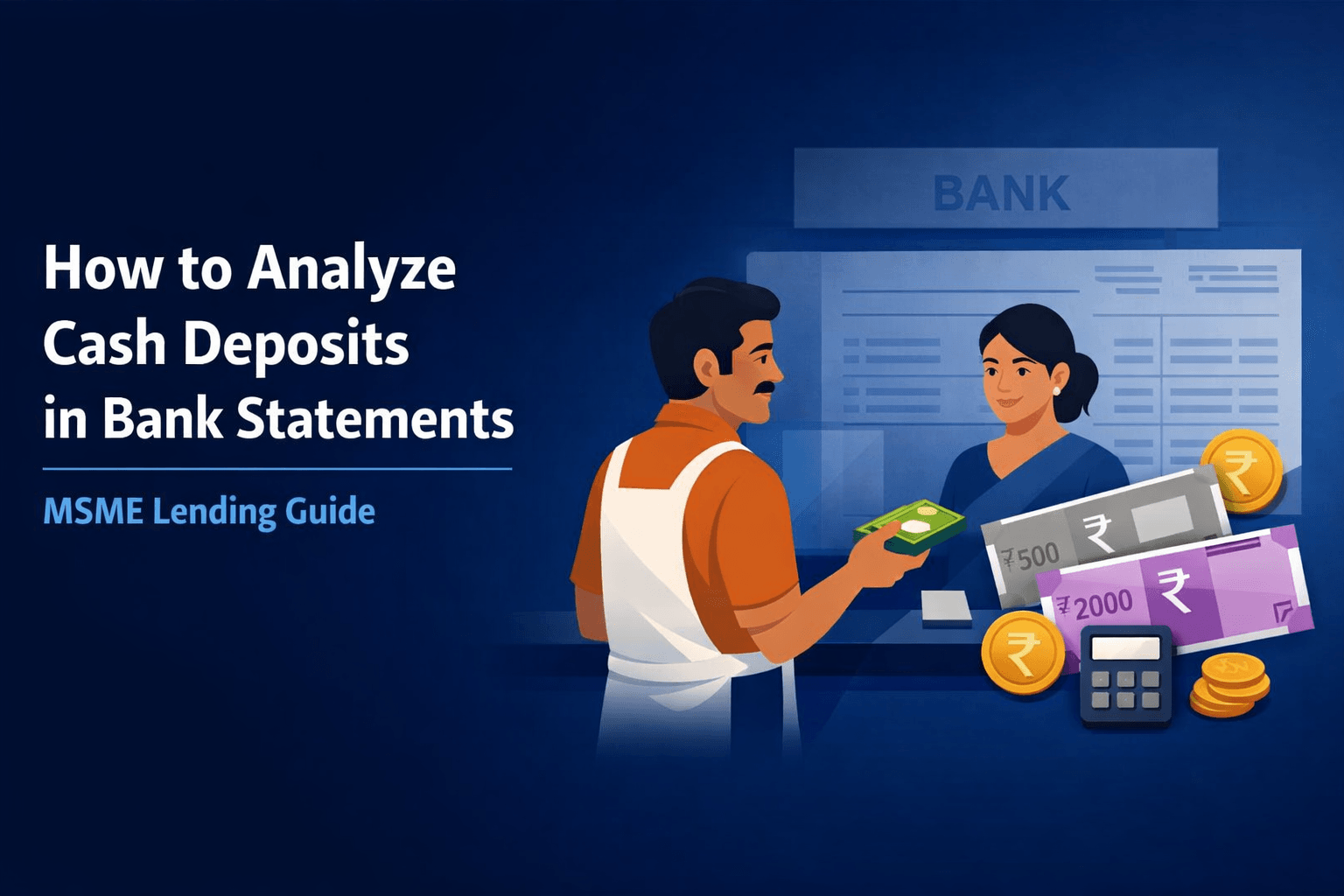
For Micro, Small, and Medium Enterprises (MSMEs) in India, cash remains king. From neighborhood kirana stores to local manufacturers, millions of businesses still operate predominantly in cash. For lenders, this presents a unique challenge: how do you accurately assess creditworthiness when a significant portion of income arrives as cash deposits in bank statements?
Cash deposit analysis has become a critical skill for NBFCs and financial institutions serving the MSME sector. Unlike salaried borrowers with predictable digital salary credits, MSME borrowers often show irregular cash deposits that require careful scrutiny to distinguish genuine business revenue from potentially manipulated transactions.
This guide walks you through proven techniques for analyzing cash deposits, identifying red flags, and making confident lending decisions even with cash-heavy borrowers.
Why Cash Deposit Analysis Matters for MSME Lending
India’s MSME sector contributes over 30% to the country’s GDP, yet remains largely underserved by traditional banking. The primary reason? The prevalence of cash transactions makes credit assessment challenging.
Nearly 65% of MSMEs in tier 2 and tier 3 cities still conduct more than 50% of their transactions in cash. This includes retail businesses, service providers, small manufacturers, and distributors. For these businesses, cash deposits represent genuine revenue. However, the same pattern can also mask fraud or circular transactions designed to inflate apparent income.
Effective cash deposit analysis helps lenders separate legitimate businesses from risky applicants, enabling financial inclusion without compromising portfolio quality
Key Elements of Cash Deposit Analysis
When reviewing bank statements with frequent cash deposits, focus on these critical aspects:
1. Deposit Frequency and Pattern
Are cash deposits regular (daily, weekly) or sporadic? Do deposits align with typical business cycles?
Red Flag Example: A retail shop claiming daily operations but showing cash deposits only 2-3 times per month.
Legitimate Pattern: A kirana store showing small daily deposits (₹2,000-₹8,000) six days a week, with Sunday gaps.
2. Deposit Amount Consistency
Are amounts within the expected range for the business type? Do deposits show natural variation or suspicious uniformity?
Red Flag Example: Deposits of exactly ₹49,500 or ₹49,900 (just below the ₹50,000 reporting threshold) appearing repeatedly.
Legitimate Pattern: Varying amounts like ₹12,340, ₹8,750, ₹15,200 showing natural daily sales fluctuation.
3. Ratio to Total Income
Calculate: Cash Deposit Ratio = (Total Cash Deposits / Total Credits) × 100
Industry Benchmarks:
- Retail businesses: 60-80% cash deposits acceptable
- Wholesale traders: 30-50% typical
- Service businesses: 20-40% normal
- Professional services: Below 20% expected
4. Correlation with Business GST Data
Cross-verify cash deposit patterns against GST returns when available. Does total monthly cash correlate with declared B2C sales? Are cash deposits higher during months with elevated GST turnover? For comprehensive verification, many lenders perform bank statements and GST cross-verification to validate business authenticity.
Common Red Flags in Cash Deposit Analysis
🚩 Warning Sign #1: Round Number Deposits
Repeated deposits of exactly ₹10,000, ₹25,000, or ₹50,000 are suspicious. Real business cash deposits show natural variation.
🚩 Warning Sign #2: Just-Below-Threshold Amounts
Multiple deposits of ₹49,000-₹49,900 suggest deliberate structuring to avoid the ₹50,000 reporting requirement.
🚩 Warning Sign #3: Weekend/Holiday Deposits
A retail shop supposedly closed on Sundays showing regular Sunday cash deposits raises questions about fund sources.
🚩 Warning Sign #4: No Corresponding Withdrawals
High cash deposits but minimal cash withdrawals suggest the business isn’t using cash for operations—a potential circular transaction indicator. Understanding how to detect circular transactions helps identify such patterns early.
🚩 Warning Sign #5: Deposit-Transfer Pattern
Cash deposited on Day 1, immediately transferred on Day 2—repeatedly—indicates potential fund circulation rather than genuine business activity.
🚩 Warning Sign #6: Inconsistent with Business Type
A software company or export business showing 80% cash deposits doesn’t align with typical industry payment methods.
Step-by-Step Cash Deposit Analysis Process
Step 1: Categorize All Deposits
Use a bank statement analyser to automatically categorize transactions into cash deposits, digital payments, cheque deposits, and other credits.
Step 2: Calculate Key Metrics
Compute the following ratios:
- Cash deposit percentage: Cash deposits ÷ Total income
- Average deposit size: Total cash deposits ÷ Number of deposits
- Deposit frequency: Number of cash deposits per month
Step 3: Map Deposit Timing
Plot deposits on a calendar to identify day-of-week patterns, monthly clustering, seasonal variations, and unusual timing gaps.
Step 4: Cross-Verify Against Supporting Documents
Match cash deposit patterns with GST returns, ITR filings, rent receipts, utility bills, and purchase invoices.
Step 5: Assess Business Location and Type
Consider business context: rural/semi-urban areas have higher cash usage, retail naturally has more cash than B2B, and small-value transactions often happen in cash.
Industry-Specific Cash Deposit Benchmarks
| Business Type | Typical Cash % | Frequency |
| Kirana Store | 70-85% | Daily |
| Medical Shop | 60-75% | Daily |
| Restaurant | 65-80% | Daily |
| Salon/Spa | 50-70% | Daily |
| Local Manufacturing | 30-50% | Weekly |
| Wholesale Trading | 25-40% | Weekly |
| Professional Services | 10-25% | Sporadic |
These benchmarks help you quickly assess whether cash deposit patterns align with claimed business type.
How Pro Analyser Automates Cash Deposit Analysis
Manual cash deposit analysis is time-consuming and prone to errors. Pro Analyser’s bank statement analyzer automates the entire process:
Automated Features:
✅ Instant Categorization: Automatically separates cash deposits from other transactions
✅ Pattern Detection: Flags suspicious round numbers and irregular timing
✅ Ratio Calculation: Computes cash percentage, frequency, and averages automatically
✅ Red Flag Alerts: Highlights potential structuring and circular transactions
✅ Industry Benchmarking: Compares deposits against business-type norms
✅ GST Cross-Verification: Matches cash patterns with GST data when available
Time Saved: What takes 2-3 hours manually is completed in 60 seconds with automated bank statement analysis.
Best Practices for MSME Cash Deposit Assessment
1. Don’t Reject Cash-Heavy Businesses Automatically
High cash deposits aren’t inherently bad. Many legitimate MSMEs operate cash-intensive models. Focus on pattern consistency, not just cash percentage.
2. Request Supporting Documentation
Ask for shop photographs, rent agreements, GST returns, purchase invoices, and utility bills proving operational location.
3. Conduct Field Verification for Large Loans
For loans above ₹5 lakhs, consider physical verification of business premises to confirm operational reality.
4. Use Technology for Faster Analysis
Implement a robust bank statement analyzer that can process multiple statements simultaneously and flag anomalies instantly.
5. Set Clear Internal Guidelines
Define acceptable cash deposit percentages by business type, and document exceptions requiring senior approval.
Regulatory Considerations
Under the Income Tax Act and PMLA, lenders must be vigilant about cash deposits exceeding ₹50,000 in a single transaction, suspicious transaction patterns, and source verification for large deposits. Maintaining detailed analysis records demonstrates due diligence and regulatory compliance.
Conclusion
Cash deposit analysis is both an art and a science. While technology can automate detection of red flags and pattern analysis, human judgment remains essential for understanding business context and making final credit decisions.
For MSME lenders, mastering cash deposit assessment unlocks a massive underserved market. By combining automated analysis tools, industry benchmarks, GST cross-verification, and contextual business understanding, you can confidently serve cash-heavy MSMEs while maintaining strong credit standards.
Frequently Asked Questions
It depends on business type. Retail businesses can legitimately have 70-85% cash deposits, while professional services typically show under 25%.
Cross-verify with GST returns, check deposit frequency and patterns, request business location proof, and look for corresponding operational expenses.
Not always, but repeated deposits of ₹49,000-₹49,900 warrant investigation as they may indicate structuring to avoid reporting requirements.
No. Many legitimate MSMEs are cash-intensive. Focus on pattern consistency, business type alignment, and supporting documentation.
Ready to Master MSME Cash Deposit Analysis?
Pro Analyser’s Bank Statement Analyser gives you instant cash deposit analysis, automated red flag detection, and comprehensive reports in 60 seconds.
Start Your Free 3-Day Trial →✓ Analyze cash patterns automatically
✓ Detect suspicious deposits instantly
✓ Make confident MSME lending decisions
✓ No credit card required