The borrower who earns well – but confuses every underwriting model
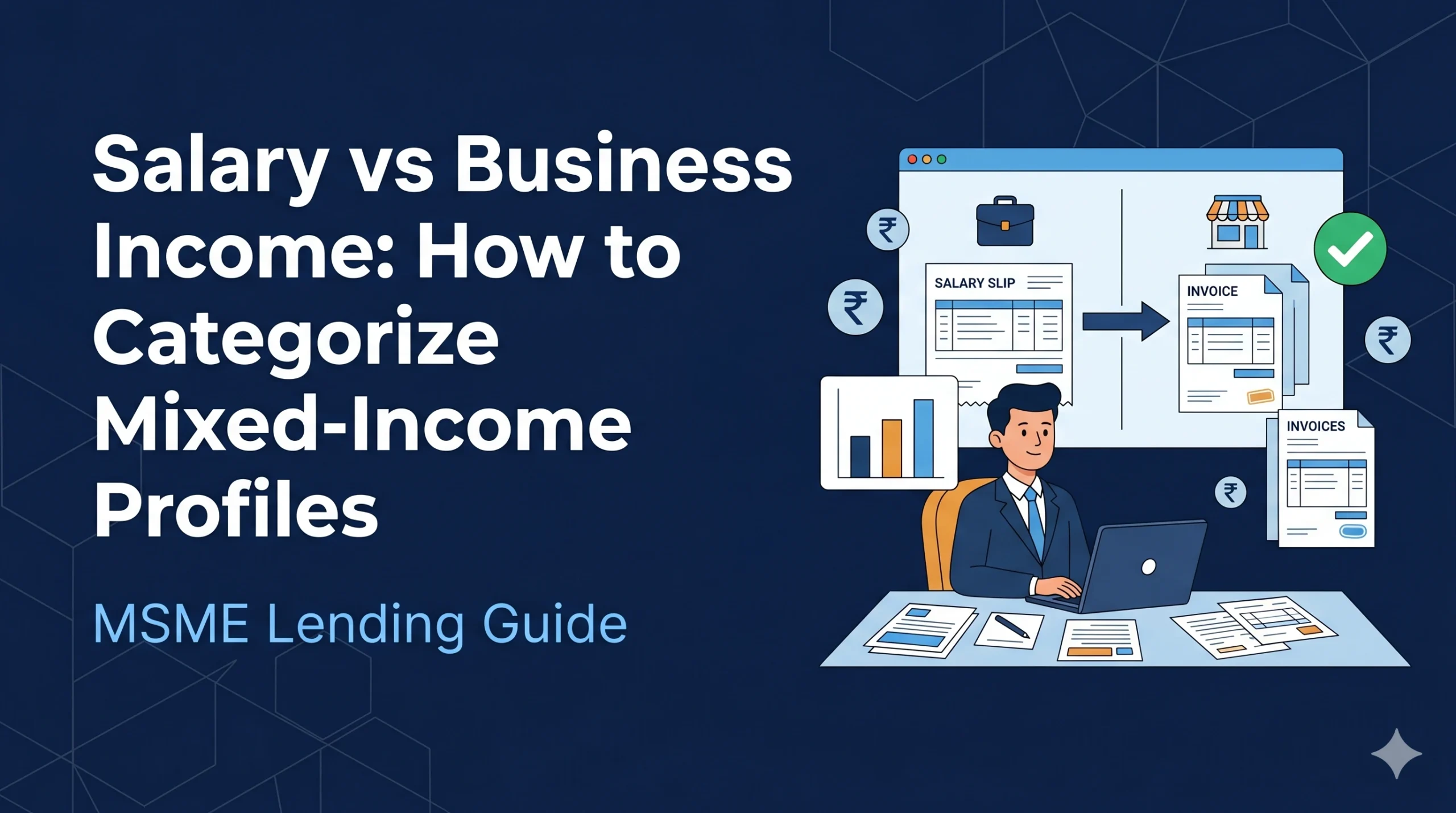
The application arrives. Monthly credits look healthy. The number is there. But when your team runs it through a bank statement analyser, the picture fragments — some credits are salary, some are business transfers, some are client payments, and one month shows a large one-time inflow that skews everything upward.
This is a mixed-income profile. And it is more common than most credit teams are prepared for.
India’s workforce is not neatly salaried anymore. According to the Reserve Bank of India’s financial inclusion data, a significant and growing share of borrowers combine formal employment income with freelance, rental, or business revenue. For lenders, that creates a classification problem — and a risk problem.
Accurate income classification is not a back-office formality. It is the foundation of every FOIR calculation, every repayment capacity assessment, and ultimately, every lending decision you make on a mixed-income file.
What is income classification and why does it break down for mixed earners
Income classification is the process of identifying, labelling, and weighting different income streams within a borrower’s financial profile to arrive at a reliable net monthly income figure for underwriting purposes.
For a purely salaried borrower, it is straightforward. One employer, one credit, one number.
For a mixed-income borrower, it becomes a judgment call — and judgment calls without a structured framework produce inconsistency. Two underwriters reviewing the same file can arrive at net monthly income figures that differ by 20–30%, depending on how they treat irregular business credits.
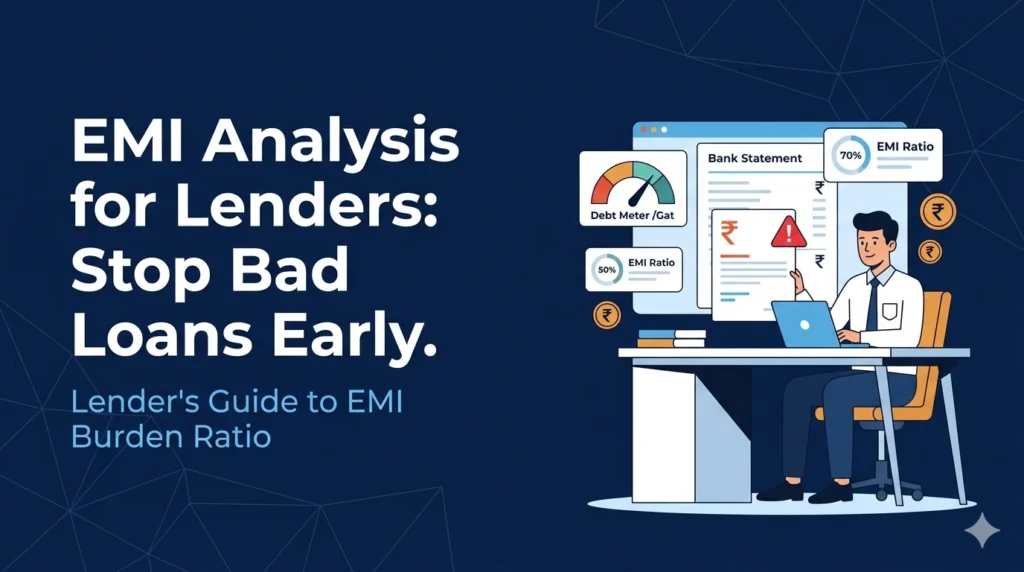
EMI Burden Ratio = (Total Monthly EMI Obligations ÷ Classified Net Monthly Income) × 100
The denominator in that formula is only as reliable as your income classification process. Get it wrong and your FOIR thresholds mean nothing.
To understand how lenders use bank statement data to build that denominator accurately, check out our blog on How Bank Statement Analysis Works.
The four income types hiding inside a mixed-income bank statement
Before classifying, your team needs to know what they are looking for. Mixed-income profiles typically contain some combination of the following:
1. Fixed salary credits Regular, same-date, same-amount transfers from a single employer. These are the most stable and should be weighted at full value in net monthly income calculation.
2. Variable business income Irregular credits from multiple parties — clients, customers, aggregators. Amount varies month to month. Should be averaged across 12 months minimum, not 3, to remove seasonal distortion.
3. Rental or passive income Recurring credits from tenants or investment returns. Moderately stable but subject to vacancy risk. Weight at 70–80% of declared value unless ITR confirmation is available.
4. One-time or windfall credits Large inflows that appear once — asset sales, insurance claims, family transfers. These must be excluded entirely from net monthly income calculation. Including them inflates the denominator and artificially deflates the EMI burden ratio.
The core discipline of income classification is distinguishing repeatable income from non-repeatable income. Only repeatable income should enter your underwriting model.
For a deeper look at how hidden income patterns reveal themselves in transaction data, explore our blog on Six Hidden Data Points That Predict Financial Health.
👉 Tired of manually sorting income types across hundreds of applications? Try our bank statement analyser — it auto-categorizes salary, business, and irregular credits so your team can focus on decisions, not data cleaning.
How to build a classification framework for mixed-income underwriting
A consistent framework removes subjectivity and protects your portfolio from both over-approval and unnecessary rejections. Here is a practical structure credit teams can implement immediately.
Step 1: Pull 12 months of bank statements, not 6
For mixed-income profiles, a 6-month window is insufficient. Business income is seasonal. A 12-month view captures at least one full cycle and gives you a defensible average.
Step 2: Separate credits by source type
Use a bank statement analyzer to tag each inflow: employer transfer, UPI business receipt, NEFT from known entity, rental credit, or unclassified. Do not mix categories in your income total.
Step 3: Apply income stability weightings
Not all income is equal in underwriting. Use a tiered weighting:
| Income type | Recommended weighting |
| Fixed salary | 100% |
| Consistent business income (12-month avg.) | 80–90% |
| Variable business income (irregular) | 60–70% |
| Rental / passive income | 70–80% |
| One-time / windfall credits | 0% — exclude |
Step 4: Cross-validate with ITR
Bank statement income classification should always be cross-referenced against the borrower’s ITR. Significant divergence between declared income and actual credits is itself a risk signal — not just a data discrepancy. Investopedia’s guide on income verification for lending highlights this cross-validation as a best practice in responsible credit underwriting.
To see how ITR data strengthens income classification for lenders, read our blog on ITR Analysis for Credit Assessment: Smarter Lending Decisions.
The three classification mistakes that inflate default risk
Even experienced credit teams make these errors on mixed-income files. Knowing them is the first step to eliminating them.
Mistake 1: Using peak-month income as the baseline A borrower’s best month is not their typical month. Always use an average, and for volatile earners, consider using the median rather than the mean to reduce the influence of outlier months.
Mistake 2: Treating all UPI credits as business income Personal transfers, family support, and split bill reimbursements appear as UPI credits. Including these as business income overstates repayment capacity. Look for patterns — business income is typically from multiple unique senders at semi-regular intervals.
Mistake 3: Skipping ITR cross-validation for small-ticket loans The logic that “it’s a small loan, so it doesn’t need full verification” is exactly how small-ticket portfolios accumulate systemic NPA risk. Income classification discipline should be consistent across all loan sizes.
To understand how these classification errors show up as red flags in bank statement data, check out our blog on Bank Statement Analysis: Hidden Red Flags.
👉 Simplify income classification across your entire loan book. Get started with our bank statement analysis tool and apply consistent, automated income categorization — from the first application to disbursement.
Building a lending decision you can defend
Mixed-income borrowers are not high-risk by default. Many are highly creditworthy — their income is simply more complex to read.
The lenders who serve this segment well are not the ones who approve blindly or reject conservatively. They are the ones who have built a structured income classification process that separates repeatable income from noise, cross-validates with ITR, and feeds a reliable net monthly income figure into every FOIR and repayment capacity calculation.
That is not a technology problem. It is a process problem — and process is something every credit team can fix.
The data is in the bank statement. Accurate income classification is what turns that data into a decision you can stand behind.
👉 Don’t let mixed-income profiles slow down your underwriting. Explore our bank statement analyser and make income classification faster, consistent, and audit-ready — starting today.