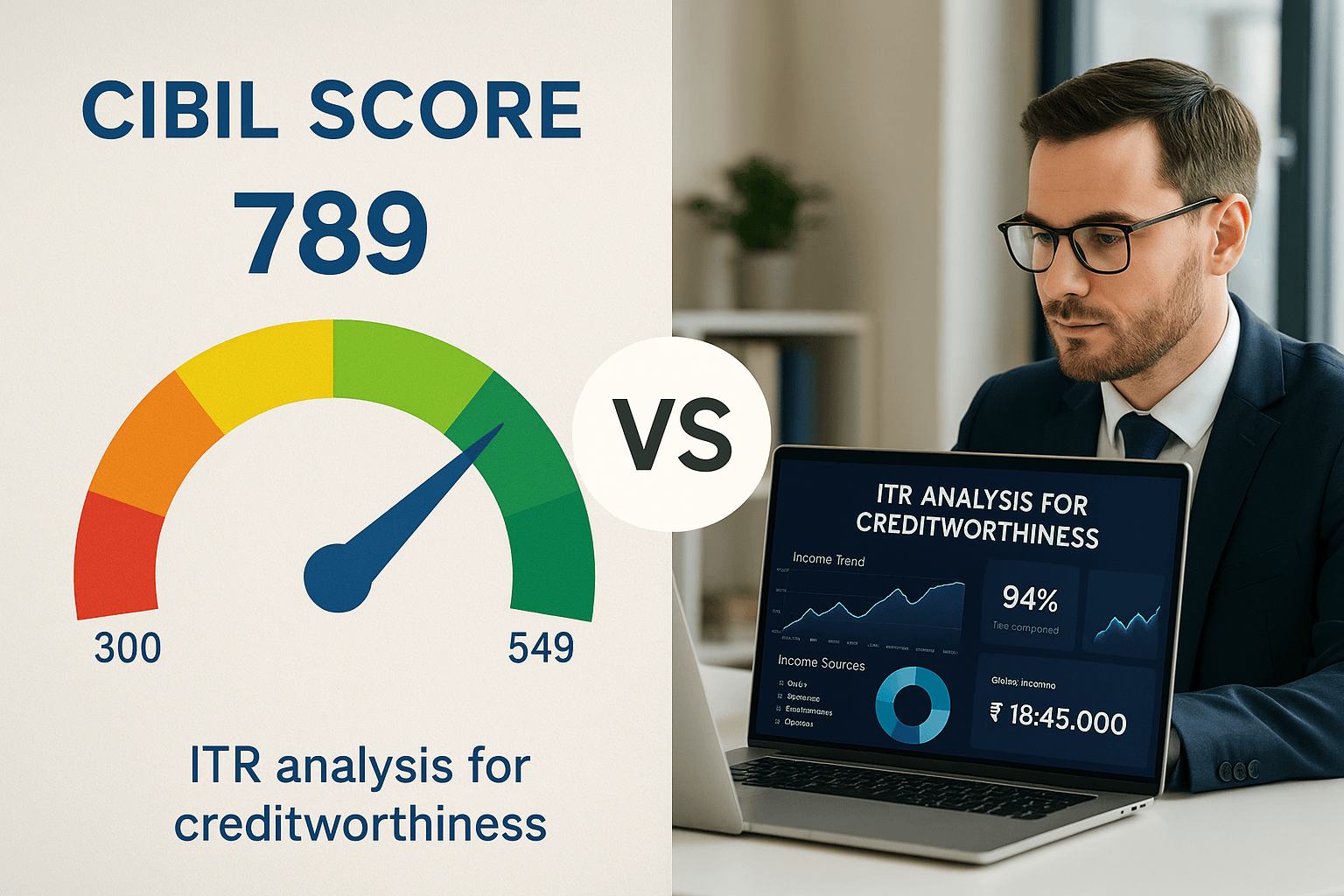
Lenders traditionally rely on CIBIL scores for quick credit checks, standardizing the initial gauge of repayment potential. However, a high score doesn’t guarantee a borrower’s ability to repay. Seasonal income, hidden liabilities, or unreported earnings can easily bypass standard credit evaluations, making robust Income Verification for Loan approval a critical necessity.
This is where ITR Analysis steps in. By diving into a borrower’s Income Tax Returns (ITR), lenders, NBFCs, and DSAs can uncover the full financial picture—income trends, tax compliance, and actual repayment capacity. It’s the definitive step that goes beyond a single credit score, transforming preliminary data into effective Credit Risk Assessment.
The Problem with Relying Only on CIBIL for Loan Income Verification
CIBIL scores reflect credit history, repayment behavior, and outstanding debts. But they critically fail to capture a borrower’s financial stability or underlying income trends, which are the cornerstones of effective Income Verification for Loan purposes.
CIBIL Limitations:
- Misleading Behavior: A borrower might maintain a high CIBIL score by servicing small loans while their primary source of income is unstable or declining.
- Short-Term View: Credit behavior offers a narrow, short-term view that can misrepresent long-term repayment capacity.
- Missing Financial Substance: CIBIL misses vital indicators like inconsistent revenue, declining business profits, or unreported side income—all crucial for accurate NBFC lending and risk management.
By combining ITR insights with CIBIL data, it becomes clear that relying solely on credit scores is insufficient. To accurately assess creditworthiness, lenders need deeper, verified financial data—the true foundation of robust Income Verification for Loan.
Want to explore this further? Check out our blog on Pro Analyser ITR Verification in Loan Process Made Easy.
👉 Want to see how an Automated ITR Analysis Tool can simplify your workflow? Try it now!
ITR Analysis: The Definitive Layer in Income Verification for Loan
Income Tax Returns are a comprehensive source of verified financial information. ITR analysis provides the deep insights necessary for accurate Credit Risk Assessment that CIBIL cannot offer:
| ITR Analysis Reveals | Impact on Lending Decision |
| Income Stability & Trends | Confirms if income is consistent, growing, or fluctuating year-on-year. |
| Profit & Expense Patterns | Detects irregular deductions, unusual expenditure, or potential manipulation. |
| Tax Discipline | Late filings or mismatches signal potential risk in financial management. |
| Multiple Verified Income Sources | Strengthens repayment capacity by verifying freelance, rental, or business income. |
| Business Health (SMEs) | Provides verified turnover and net profit trends critical for business loan approvals. |
In essence, ITR analysis gives lenders a detailed, realistic view of the borrower’s ability to meet future obligations, making it the gold standard for Income Verification for Loan applications.
For additional insights, see our related blog: Income Proof Verification for Loans – How ITR Simplifies Lending.
The Smarter Approach: Combining ITR Analysis and CIBIL Scores
The most effective strategy isn’t to choose one data source over the other, but to use both for a truly holistic view. This dual-layer approach significantly improves NBFC Lending outcomes.
- CIBIL provides behavioral insights: how borrowers manage existing debt.
- ITR Analysis provides financial substance: whether they can truly afford the new loan.
Example of Enhanced Credit Risk Assessment:
| Borrower | CIBIL Score | ITR Income Trend | Outcome via Dual-Layer Verification |
| A | 780 (High) | Declining over two years | High Risk – Income instability jeopardizes repayment. |
| B | 680 (Average) | Stable and Growing | Low Risk – Strong, verified income supports the loan. |
By combining ITR-based income data with CIBIL scores, lenders achieve a 360° view of borrower risk. This leads to smarter approvals, fewer defaults, and superior portfolio quality, especially in competitive NBFC lending environments.
For more strategies, check out our related post: ITR Analysis for NBFCs – Reduce Defaults, Grow Clients.
👉 Get actionable insights with the ITR Analyser – Start today.
The Future of Loan Income Verification: Automation
Manually reviewing ITRs is slow, inconsistent, and highly prone to error. Automated ITR Analysis Tools solve this challenge, making robust Income Verification for Loan practical at scale:
- Instant Metrics: Extracts and summarizes key financial figures (gross income, deductions, trends) instantly.
- Fraud Detection: Automatically flags inconsistencies or potential manipulation in returns, drastically improving Credit Risk Assessment.
- Standardized Scoring: Provides objective, data-driven scoring, ensuring consistency across all loan files.
- Faster TAT: Speeds up approval cycles without compromising the accuracy of the Income Verification for Loan process.
For lenders, NBFCs, and DSAs, these tools convert complex tax data into actionable lending decisions, essential for modern risk management.
Check our guide: ITR for NPA Reduction – Smarter Lending Strategies in 2025.
Conclusion
The era of relying solely on credit scores for Income Verification for Loan decisions is over. Lenders need the deeper, verified financial visibility that only ITR Analysis can provide—highlighting income stability, tax discipline, and true repayment capacity.
Combining verified ITR insights with CIBIL scores isn’t just a smart upgrade; it’s essential for minimizing risk in today’s dynamic lending market. Lenders who embrace this approach can reduce defaults, identify high-quality borrowers previously missed by traditional scoring, and make faster, more confident credit decisions.
👉 Ready to transform your Income Verification for Loan process? Explore the ITR Analysis Tool and simplify risk assessment today!