In India’s rapidly evolving digital lending ecosystem, Non-Banking Financial Companies (NBFCs) face a sophisticated threat: circular transactions. These orchestrated money flows create the illusion of legitimate business activity or income, deceiving underwriters and artificially inflating creditworthiness.
Unlike simple document tampering, circular transactions involve real money movements making them extremely difficult to identify through manual verification. However, with advanced bank statement analysis technology, NBFCs can now detect circular transactions before they lead to loan defaults and portfolio damage.
This guide explores what circular transactions are, the red flags to watch for, and how automated tools like Pro Analyser’s Bank Statement Analyser can protect your lending business.
What Are Circular Transactions in Bank Statements?
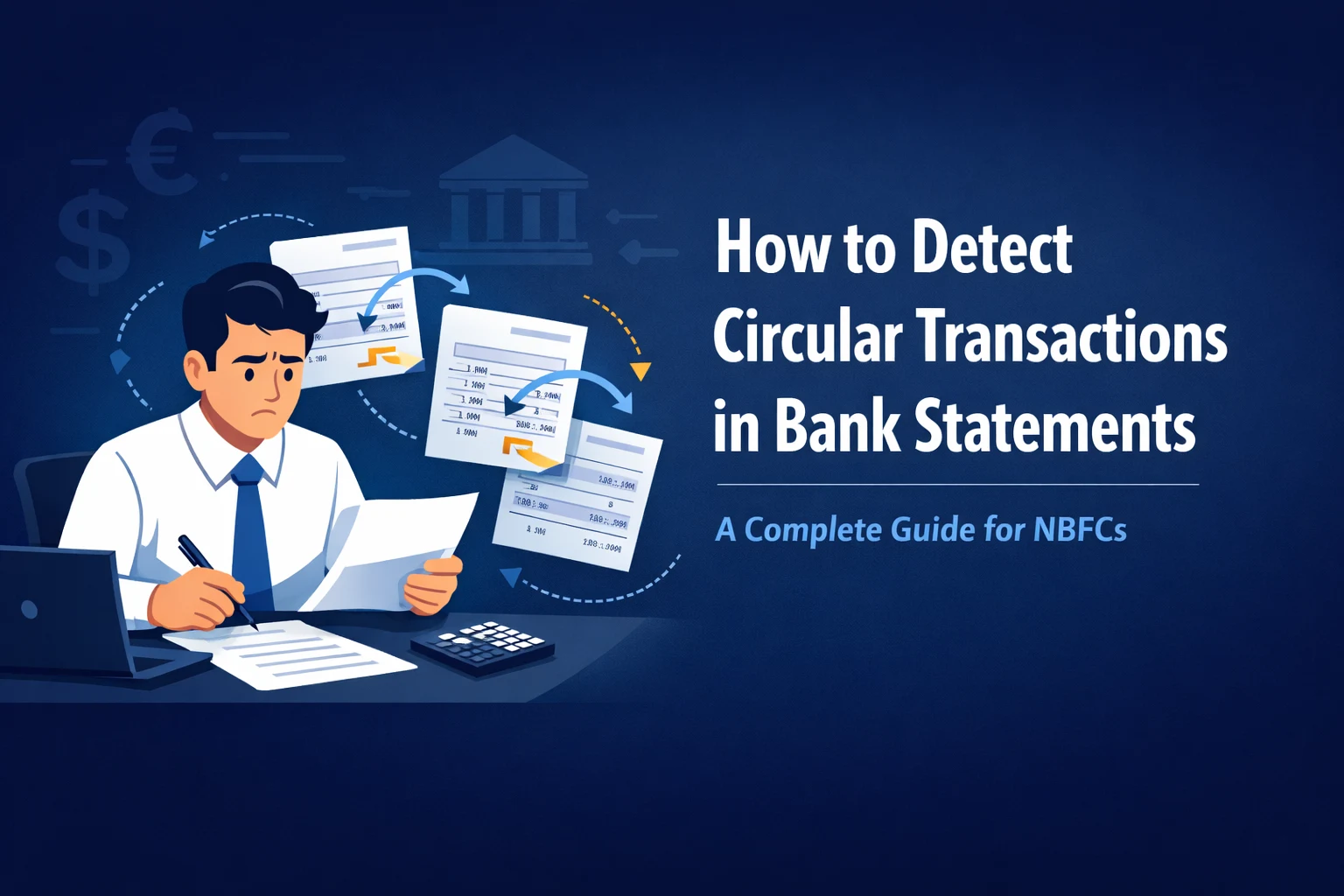
Circular transactions refer to systematic fund transfers between multiple accounts, often controlled by the same individual or connected entities, designed to create an artificial trail of financial activity. The money eventually returns to its origin, completing a “circle.”
Common Scenarios:
-
Self-Funding Loops: A borrower transfers ₹50,000 to a friend’s account, who transfers it back within days, creating the appearance of regular income.
-
Business-to-Business Manipulation: A business owner creates invoices between their own entities, moving money back and forth to inflate turnover.
-
Salary Simulation: An individual receives “salary” deposits from a company they control, making it appear as employment income.
-
Cash Deposit Circles: Multiple cash deposits followed by transfers to related accounts, designed to legitimize unaccounted money.
The goal is to manipulate cash flow patterns and create a facade of financial stability to secure loan approvals.
Why Circular Transactions Are Dangerous for NBFCs
For NBFCs operating with high volumes and competitive margins, circular transaction fraud poses critical risks:
1. Inflated Creditworthiness
Borrowers appear to have steady income when no genuine value creation is occurring, leading to approving loans for customers with no actual repayment capacity.
2. Higher NPA Rates
When loans are disbursed based on fabricated financial health, defaults are inevitable. The borrower lacks genuine cash flow to service the debt, pushing loans into NPA territory.
3. Regulatory Compliance Issues
The RBI has tightened KYC and AML norms. NBFCs failing to detect circular transactions may face regulatory penalties for inadequate due diligence.
4. Reputational Damage
Repeated fraud incidents erode investor confidence and damage market reputation, making it harder to raise capital or attract quality borrowers.
Key Red Flags to Detect Circular Transactions
Manual review rarely catches sophisticated schemes, but certain patterns serve as strong fraud indicators:
1. Frequent Round-Number Transfers
Transfers of exactly ₹10,000, ₹25,000, or ₹50,000 at regular intervals are suspicious. Genuine transactions rarely occur in perfect round numbers consistently.
2. Same-Day or Next-Day Reversals
Money entering and exiting within 24-48 hours, especially to the same party or related accounts, is a classic circular transaction indicator.
3. Matching Inflow-Outflow Amounts
When credit and debit transactions consistently match in amount over time, it suggests funds are being circulated rather than used for genuine expenses.
4. Transfers to Similar Account Names
Multiple transactions to accounts with name variations, “Sharma Enterprises,” “Sharma Trading,” “Sharma & Co.” often indicate single-person control over multiple entities.
5. Low Balance Despite High Turnover
An account showing ₹5 lakh monthly turnover but maintaining only ₹5,000-₹10,000 average balance signals money passing through without retention for genuine operations.
6. Absence of Business Expenses
A business account with high inflows but no utility bills, salaries, rent, vendor payments, or GST outflows is highly suspicious.
Understanding these patterns is crucial, which is why learning how to conduct a credit assessment using bank statements comprehensively can significantly improve your fraud detection capabilities.
How Pro Analyser Detects Circular Transactions Automatically
While manual detection is time-consuming and error-prone, Pro Analyser’s Bank Statement Analyser automates the entire process using AI-powered algorithms. Here’s how it works:
Advanced Circular Transaction Detection Feature
Pro Analyser’s BSA tool includes a dedicated circular transaction detection module that automatically:
- Maps Transaction Networks: Identifies all counterparties and flags accounts with high interconnectivity
- Analyzes Transaction Timing: Detects same-day or near-immediate reversals across months of data
- Calculates Fraud Ratios: Computes circular transaction percentage, pass-through ratios, and balance-to-turnover metrics
- Flags Suspicious Patterns: Highlights round-number transfers, matching amounts, and related-party transactions
Key Benefits for NBFCs:
✅ Saves Time: Analyze 6-12 months of statements in under 60 seconds instead of 2-3 hours manually
✅ Reduces Risk: Catch sophisticated fraud patterns that manual reviews miss
✅ Improves Accuracy: AI-powered detection eliminates human error and inconsistency
✅ Comprehensive Reports: Get detailed BSA reports with circular transaction flags highlighted
✅ Regulatory Compliance: Maintain audit trails demonstrating due diligence efforts
The circular transaction detection is one of over 100+ data points analyzed in Pro Analyser’s comprehensive BSA report, helping NBFCs make informed lending decisions faster and more confidently.
For NBFCs processing high volumes, understanding statement fraud detection techniques and implementing automated solutions is no longer optional, it’s essential for portfolio health.
Real-World Detection Example
Scenario: An NBFC received a ₹10 lakh loan application from a business owner showing ₹8 lakh monthly turnover in bank statements.
Manual Review: Nothing unusual, regular deposits labelled as “business receipts.”
Pro Analyser Analysis:
- Network Flag: 60% of deposits came from three related entities
- Timing Alert: Money received on 5th was transferred out on 7th monthly
- Low Retention: ₹8 lakh turnover, only ₹12,000 average balance
- GST Mismatch: GST returns showed ₹2.5 lakh quarterly vs. ₹8 lakh monthly claimed
Outcome: Application rejected. Investigation confirmed all three entities were controlled by the applicant, circulating the same ₹2-3 lakh repeatedly.
This case demonstrates why NBFCs are increasingly adopting fraud detection in loan approvals systems to protect their portfolios.
Best Practices for NBFCs
1. Implement Automated Analysis
Use a robust bank statement analyzer like Pro Analyser that includes circular transaction detection as a standard feature.
2. Cross-Verify Multiple Data Sources
Don’t rely on bank statements alone. Match findings against GST returns, ITR filings, and credit bureau data.
3. Set Clear Risk Thresholds
Define rules like: “If circular transaction ratio >30%, flag for manual review” or “If balance-to-turnover ratio <2%, auto-reject.”
4. Train Your Credit Team
Ensure credit officers understand circular transaction patterns and can interpret automated alerts effectively.
5. Maintain Audit Documentation
Keep detailed records of all flagged cases for regulatory compliance and portfolio reviews.
Technology Advantage: Why Automation Wins
| Aspect | Manual Review | Pro Analyser BSA |
| Time per application | 2-3 hours | 30-60 seconds |
| Accuracy | 60-70% | 95%+ |
| Detection depth | Surface patterns | 100+ data points |
| Consistency | Varies by analyst | Standardized |
| Cost per analysis | High (labor) | Low (automated) |
Regulatory Compliance
The RBI’s Master Direction on Fraud Classification and Reporting (2023) requires NBFCs to implement systems for early fraud detection. Pro Analyser’s Bank Statement Analyser helps you:
- Maintain robust customer due diligence
- Create audit trails for all analyzed applications
- Demonstrate proactive fraud prevention measures
- Meet digital lending guidelines for automated underwriting
Conclusion: Protect Your Portfolio with Smart Detection
Circular transactions represent one of the most challenging fraud types in modern lending. As schemes grow more sophisticated, manual detection simply cannot keep pace. NBFCs that leverage automated bank statement analysis tools gain a significant competitive advantage approving good loans faster while protecting against fraud.
Pro Analyser’s BSA tool makes circular transaction detection effortless. With AI-powered analysis, comprehensive reporting, and fraud pattern recognition built in, you can detect circular transactions in seconds, reduce risk, and maintain portfolio quality.
Don’t let sophisticated fraud drain your lending business. The right technology saves time, reduces NPAs, and strengthens your underwriting process.
Frequently Asked Questions
Pro Analyser analyses bank statements in 30-60 seconds, flagging circular transactions and 100+ other data points instantly.
Industry estimates suggest 5-12% of unsecured lending applications show some circular transaction activity.
Yes, Pro Analyser’s BSA supports 150+ bank statement formats with high-accuracy OCR for both digital and scanned PDFs.
Yes, it’s a core feature of Pro Analyser’s comprehensive BSA report, along with fraud flags, income verification, and cash flow analysis.
Take Action: Start Detecting Fraud Automatically
Stop losing time and money to circular transaction fraud. Pro Analyser’s Bank Statement Analyser gives you instant fraud detection, comprehensive analysis, and faster loan decisions.
✓ Detect circular transactions automatically
✓ Analyze 100+ data points in seconds
✓ Reduce NPAs by up to 40%
✓ No credit card required
About Pro Analyser
Pro Analyser is India’s leading financial data analysis platform trusted by 500+ NBFCs and DSAs for automated credit assessment, fraud detection, and faster loan approvals.