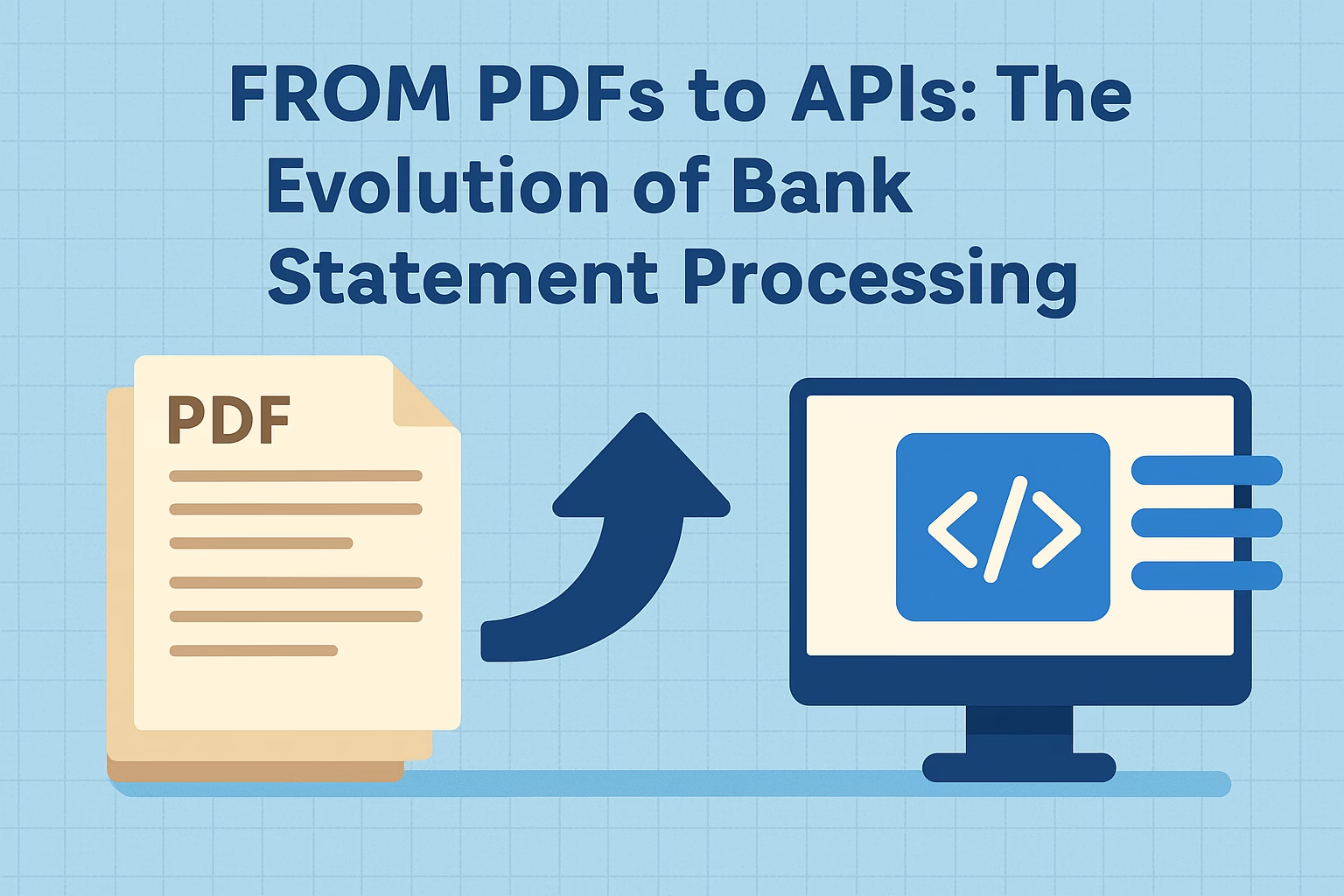
Bank statement processing has long been the foundation of credit decision-making. For decades, lenders relied on bank statements as the most reliable indicator of a borrower’s financial health. Yet despite their importance, the way bank statement processing was handled remained inefficient, manual, and highly vulnerable to error.
Lenders lost years navigating PDFs, Excel files, and scanned statements. Manual bank statement Analysis slowed approvals, inflated operational costs, and quietly increased fraud risk. What should have been a source of clarity often became a bottleneck.
That reality has changed.
APIs have redefined bank statement Analysis from a labour-intensive chore into a real-time intelligence engine.
The Legacy Era of Bank Statement Analysis: PDFs and Human Error
In the early 2000s, bank statement processing was entirely manual. Loan officers reviewed statements page by page, verified balances, calculated average income, and flagged anomalies using subjective judgment.
The process was slow. Exhausting. Inherently fragile.
Challenges of traditional bank statement processing included:
- Editable PDFs that borrowers could manipulate with basic tools
- Human error compounding as officers reviewed hundreds of applications
- Loan approvals delayed by days or even weeks
As lending markets became faster and more competitive, this form of bank statement Analysis became unsustainable.
OCR in Bank Statement Processing: Progress Without Precision
Optical Character Recognition (OCR) introduced partial automation into bank statement processing. Scanned statements could be digitized, and some manual effort was reduced. Banks and NBFCs welcomed the change.
However, OCR exposed new limitations.
Fonts, watermarks, and inconsistent layouts frequently confused extraction engines. Lenders still had to manually verify outputs. Fraud detection in OCR-based bank statement Analysis remained superficial.
OCR improved efficiency, but it did not fundamentally solve the core risks associated with bank statement Analysis.
API-Driven Bank Statement Processing: Speed With Certainty
The real transformation arrived with Bank Statement Analysis APIs.
API-based bank statement Analysis eliminates document uploads altogether. With borrower consent, APIs connect directly to banking data and generate structured, real-time insights.
Why API-led bank statement processing is superior:
- Instant processing: Statements analyzed in seconds, not hours
- Robust fraud detection: Identification of anomalies, synthetic transactions, and tampered data
- Standardized outputs: Uniform data regardless of bank format
- Scalable infrastructure: Consistent performance from 10 to 10,000 applications
This evolution is not just about speed. Modern bank statement processing is built on trust—verified data, secure transmission, and audit-ready trails.
Why Bank Statement Analysis APIs Are Essential in 2025
In 2025, lending competitiveness is driven by operational intelligence, not just pricing. Efficient bank statement processing is now a strategic differentiator.
API-powered bank statement Analyser enables lenders to:
- Reduce operational costs by eliminating manual checks
- Deliver near-instant approvals that improve borrower experience
- Strengthen credit risk assessment through granular cash-flow analysis
- Maintain compliance through secure, traceable data pipelines
A borrower approved in 30 minutes through intelligent bank statement processing is far more likely to convert than one waiting days for manual review.
Real-World Example: Fraud Detection Through Advanced Bank Statement Analyser
A borrower submits a PDF showing consistent salary credits. On the surface, everything appears legitimate.
API-driven bank statement processing reveals the truth.
Transaction-level analysis identifies replicated entries—credits that were copied, not transferred. The system flags the inconsistency instantly.
Fraud is filtered out. Genuine applicants move forward without friction.
This is the precision modern bank statement Analysers delivers.
Bank Statement Analysing Within the Modern Lending Tech Stack
A lending platform built for scale cannot function without advanced bank statement Analysis APIs. They operate alongside:
- KYC verification APIs for identity authentication
- Credit bureau APIs for repayment behavior
- GST APIs for business cash-flow analysis
At the centre of this ecosystem sits bank statement Analysis validating, extracting, and interpreting financial behaviour with consistency and depth.
This API-first architecture is redefining how NBFCs, DSAs, fintechs, and auditors operate, making bank statement processing faster, safer, and infinitely scalable.
Where to Begin With Modern Bank Statement Analysis
If your workflows still depend on PDFs or OCR-heavy tools, your bank statement Analysis framework is already lagging. APIs are no longer optional enhancements—they are the industry baseline.
This shift explains the rapid adoption of solutions such as Pro Analyser’s Bank Statement Analyser. Beyond bank statement Analysis, Pro Analyser’s GST Analyser enhances credit assessment by integrating verified tax data in real time.
Together, these APIs embed seamlessly into lending workflows, delivering accurate financial insights at machine speed.
👉 Learn more about our Bank Statement Analysis API
Final Thoughts on the Future of Bank Statement Analysis
The transition from PDFs to APIs is not merely a technological upgrade. It is a survival imperative.
Borrowers demand immediacy. Regulators demand transparency. Competitors are already optimizing their bank statement processing pipelines.
Bank statements are no longer static records. They are dynamic data streams.
The lenders who succeed in 2025 will be those who master modern bank statement analysis —turning raw financial data into faster decisions, stronger risk controls, and lasting customer trust.