In lending, numbers alone do not tell the full story. Balance sheets can be outdated. Financial ratios can be engineered. Collateral values fluctuate. What consistently reflects a borrower’s true repayment ability is cash flow.
That is why cash flow assessment has become central to modern credit underwriting. Instead of relying solely on static financials, lenders now evaluate how money actually moves through a borrower’s accounts month after month, transaction by transaction.
At the core of this shift is bank statement analysis. With the right tools, lenders can convert raw bank statements into structured insights that power faster, more accurate lending decisions.
What Is Cash Flow Assessment in Lending?
Cash flow assessment is the process of evaluating a borrower’s ability to repay debt based on actual inflows and outflows, rather than declared income or historical financial statements.
In lending, this means analyzing:
- Regularity of income
- Stability of expenses
- Monthly cash surplus or deficit
- Volatility across time periods
Unlike traditional methods, cash flow assessment focuses on behavioral financial data, not assumptions.
Why Cash Flow Tells the Real Repayment Story
A borrower may show strong revenue on paper but struggle with irregular inflows or high fixed expenses. Cash flow exposes this reality.
For MSMEs, self-employed borrowers, and gig workers, where formal financials are often limited, cash flow assessment is often the most reliable indicator of creditworthiness.
If you want to go deeper into how lenders interpret inflows, outflows, and surplus trends, explore our detailed guide on cash flow analysis using bank statements.
Why Traditional Credit Assessment Falls Short
Traditional underwriting methods were built for salaried borrowers and asset-heavy businesses. They rely heavily on:
- Balance sheets
- Financial ratios
- Collateral coverage
- Credit bureau scores
While useful, these inputs have clear limitations.
Balance sheets are periodic and backward-looking. Ratios hide timing mismatches. Collateral does not guarantee repayment. Credit scores often lag real financial stress.
The Shift Toward Cash Flow–Driven Lending
Modern lenders are increasingly moving toward transaction-based underwriting. By assessing borrower cash flow directly from bank statements, lenders gain:
- Real-time financial visibility
- Early risk indicators
- Better decision accuracy for thin-file borrowers
This shift is especially visible in digital lending, MSME finance, and cash flow–based loan products.
To understand how automation changes underwriting accuracy and turnaround time, read our comparison on manual vs automated bank statement analysis in lending.
Role of Bank Statement Analysis in Cash Flow Assessment
Bank statements are the most authentic source of borrower financial behavior. They capture:
- Actual income receipts
- Real operating expenses
- Loan obligations and EMIs
- Irregular or circular fund movements
However, raw bank statements often shared as PDFs are unstructured and difficult to analyze manually at scale.
This is where automated bank statement analysis becomes critical.
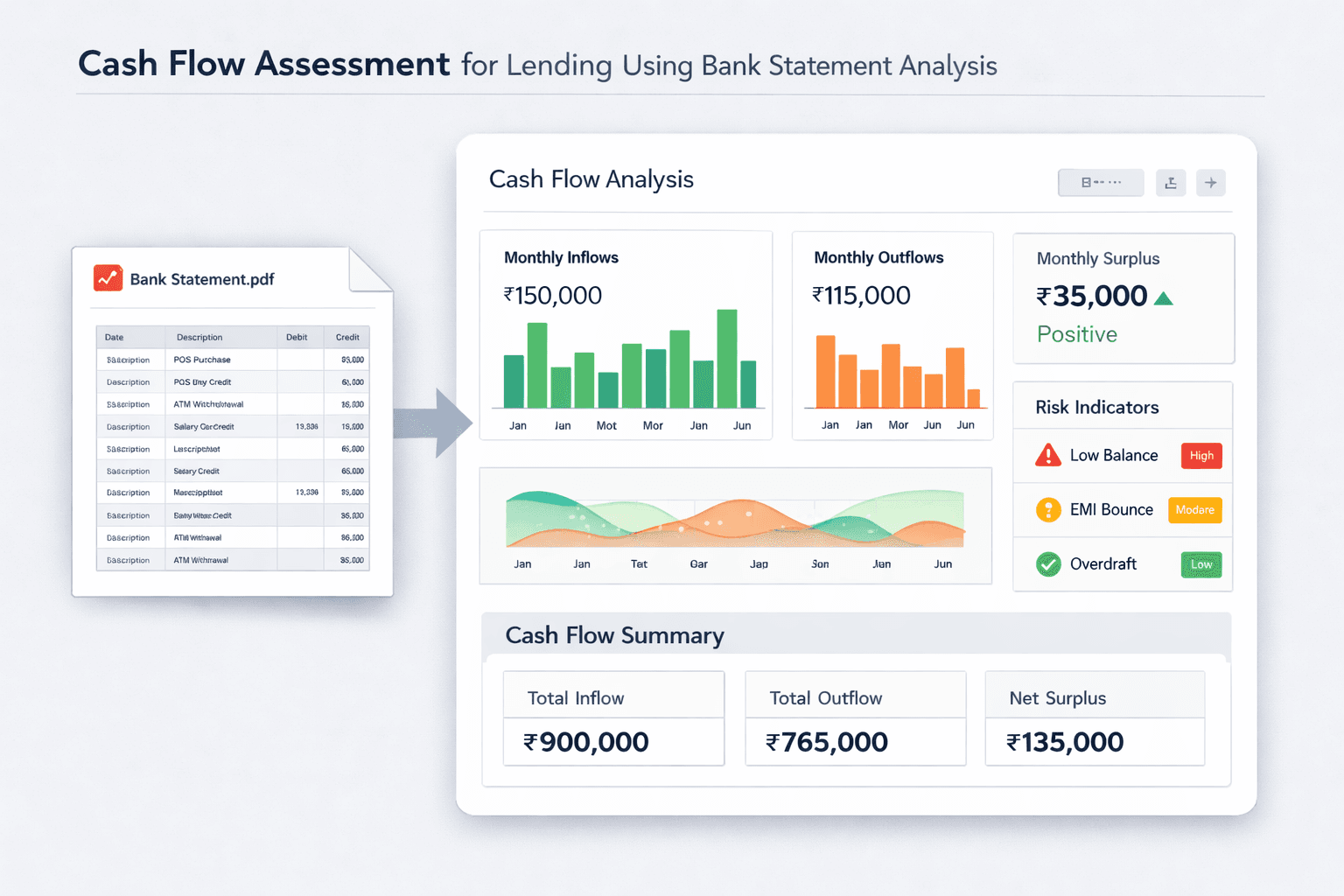
A modern bank statement analyser converts PDFs into structured data, enabling lenders to perform accurate and consistent cash flow assessment without manual intervention.
How a Bank Statement Analyser Enables Accurate Cash Flow Assessment
Manual reviews cannot scale. They are slow, inconsistent, and prone to error. Automated tools like Pro Analyser are designed specifically for lending and risk teams.
Automated Cash Flow Analysis
Pro Analyser automatically extracts transactions from bank statements and performs cash flow analysis across customizable time periods. Lenders can instantly view:
- Monthly inflows vs outflows
- Net cash surplus or deficit
- Income consistency trends
This allows credit teams to assess repayment capacity with confidence.
Circular Transaction Detection
One of the biggest risks in cash flow–based lending is inflated income created through circular transactions.
Pro Analyser identifies circular transaction patterns, helping lenders:
- Detect artificial cash inflows
- Identify fund recycling across accounts
- Reduce manipulation risk in underwriting
This insight is difficult to catch manually but critical for accurate risk assessment.
Circular transactions are one of several hidden risk signals in bank statements. Learn how lenders identify these patterns in our guide on bank statements – based fraud detection.
Tampered PDF Detection
Another overlooked risk is document manipulation. Altered or edited bank statements can mislead underwriting decisions.
Pro Analyser includes tampered PDF detection, automatically flagging statements that show signs of modification. This adds an essential layer of document integrity to the cash flow assessment process.
Document integrity is critical in lending workflows. Explore how automated tools help detect inconsistencies in our blog on fraud risks in bank statement analysis.
👉 Want to simplify and strengthen your underwriting workflow? Explore how a bank statement analyser can support accurate cash flow assessment.
Key Lending Use Cases Powered by Cash Flow Assessment
Cash flow assessment enabled by bank statement analysis supports a wide range of lending scenarios.
SME and MSME Lending
Cash flow trends provide a clearer picture of business sustainability than static financials, especially for smaller enterprises.
Self-Employed and Gig Worker Loans
Where formal income proofs are limited, transaction-level analysis becomes the primary underwriting input.
Digital and Instant Credit
Automated bank statement analysis allows lenders to assess risk quickly without compromising accuracy.
Portfolio Monitoring and Early Risk Detection
Ongoing cash flow assessment helps lenders identify stress signals early, improving portfolio quality and reducing defaults.
Why Automation Is a Competitive Advantage for Lenders
As loan volumes grow, the ability to assess cash flow consistently and quickly becomes a differentiator.
Automated cash flow assessment delivers:
- Faster credit decisions
- Lower operational cost
- Reduced human error
- Stronger audit and compliance readiness
More importantly, it allows risk teams to focus on judgment and strategy, not data cleanup.
👉 Ready to modernize your lending decisions? Try now and see how a bank statement analyzer can transform cash flow assessment.
Conclusion
Cash flow assessment is no longer optional in modern lending. It is the most reliable way to understand a borrower’s true financial health and repayment capacity.
By leveraging automated bank statement analysis, lenders can move beyond assumptions and static financials to data-driven decisions. Tools like Pro Analyser make this possible at scale, combining cash flow analysis, circular transaction detection, and tampered PDF checks into a single, streamlined workflow.
For lenders navigating risk, speed, and scale, automated cash flow assessment is not just an improvement. It is a strategic necessity.