In the high-stakes world of lending and auditing, a bank statement is more than just a list of transactions, it is the ultimate proof of a borrower’s financial health. However, as digital editing tools become more sophisticated, “doctoring” these documents has become alarmingly easy.
For years, credit officers relied on manual “sight checks” to spot inconsistencies. But today, a high-quality forgery created with professional PDF editors can bypass even the most seasoned human eye. This is where Artificial Intelligence (AI) has changed the game.
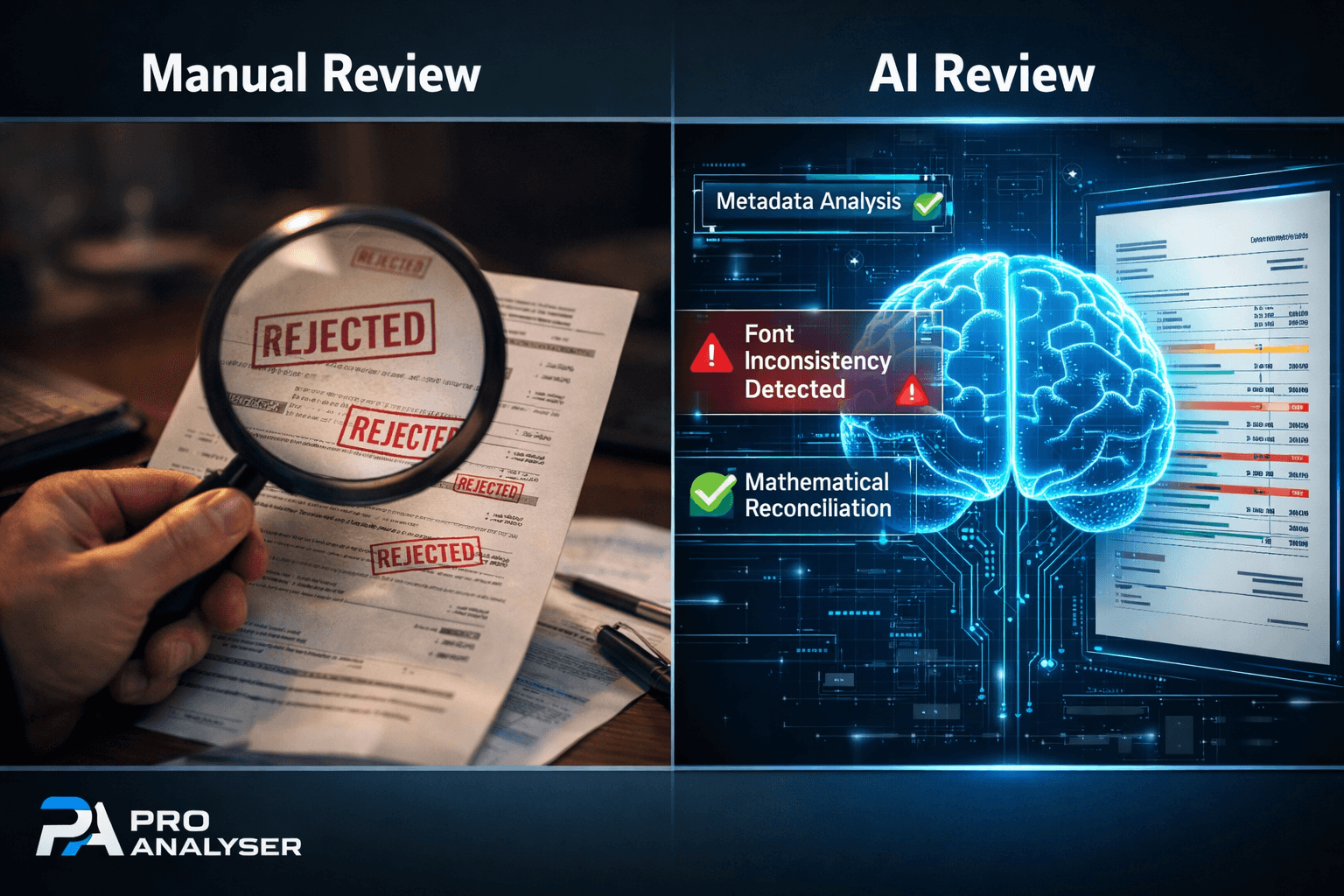
By leveraging AI-driven bank statement fraud detection, lenders can now uncover invisible anomalies that manual review simply cannot see. Here are five specific ways AI detects tampered statements that humans miss.
Forensic Metadata Analysis (The “Digital Fingerprint”)
Every digital file carries a hidden layer of information called metadata. When a bank generates an official PDF statement, the metadata typically includes the bank’s internal systems, specific creation dates, and authorized PDF versions.
The Manual Limit: A human reviewer looks at the PDF on a screen or a printout. They see the numbers and the logo, but they cannot see the “Properties” hidden in the file’s code.
The AI Advantage: AI tools immediately scan the file’s metadata for “Editing Footprints.” If a statement claims to be an official export from HDFC or SBI but the metadata shows it was “Saved by Adobe Photoshop” or “Modified by Small PDF” ten minutes before submission, the AI flags it instantly. AI can also detect “Date Mismatches,” where the document’s creation date is actually after the period it supposedly covers.
Pixel-Level Font and Alignment Inconsistencies
Fraudsters often try to inflate their income by changing a single digit (e.g., turning a ₹10,000 credit into ₹90,000). To do this, they “patch” a new number over the old one.
The Manual Limit: If the fraudster uses the same font and size, a human reviewer will likely miss it. The eye is naturally inclined to smooth over tiny misalignments.
The AI Advantage: Using Computer Vision, AI analyzes the document at a pixel level. It checks for:
- Font Variations: Even if the font looks the same, AI detects subtle differences in kerning (spacing between characters) or stroke width that occur when a different software renders a specific number.
- Grid Alignment: Official bank statements are generated by rigid automated systems. AI can detect if a single line of text is 0.5 millimeters off the vertical axis, a tell-tale sign of a manual “copy-paste” job.
Algorithmic Reconciliation (The Math Doesn’t Lie)
One of the most common mistakes in forged statements is “broken math.” A fraudster might change a credit entry but forget to update the subsequent running balances or the final closing balance for the month.
The Manual Limit: Manually verifying every single line of a 20-page bank statement is exhausting. Human reviewers often “spot check” the first and last page, leaving the middle pages vulnerable to manipulation.
The AI Advantage: An AI bank statement analyzer performs a “Total Reconciliation” in milliseconds. It recalculates every single transaction from the opening balance to the closing balance. If a single rupee is unaccounted for, the system triggers a “Math Mismatch” alert. AI also cross-verifies the “Sum of Credits” and “Sum of Debits” against the summary section, ensuring the entire document is mathematically sound.
Transactional Rhythm and Behavioral Anomalies
Authentic financial behavior has a “rhythm.” Salaries usually arrive on fixed dates; utility bills have seasonal fluctuations; and weekend spending looks different from weekday spending.
The Manual Limit: A human might notice a large deposit, but they rarely have the time to analyze the rhythm of thousands of transactions to see if they “feel” real.
The AI Advantage: AI uses Machine Learning (ML) to build a behavioral profile of the borrower. It detects “Synthetic Patterns,” such as:
- Round Number Bias: Real-world transactions (like grocery bills or fuel) rarely end in “.00.” A statement filled with perfectly round numbers is a major red flag for AI.
- Circular Transactions: AI can instantly spot “Money Looping,” where funds move between related parties to artificially inflate turnover, a tactic often used by DSAs or small businesses to qualify for larger loans.
Template Fingerprinting and Structural Deviations
Banks use highly standardized templates that rarely change. These templates have specific margins, logo placements, and footer formats.
The Manual Limit: Unless a reviewer is looking at statements from the same bank every hour, they won’t notice if a logo is slightly too large or if the “Page X of Y” notation is in the wrong corner.
The AI Advantage: Advanced AI platforms maintain a library of “Golden Templates” for every major bank. When a statement is uploaded, the AI overlays it against the known authentic template. If the header height is different or the font used for the “Account Number” doesn’t match the bank’s standard, the AI identifies it as a “Template Deviation.” This is particularly effective at catching “Template Farm” forgeries, standardized fakes sold online to fraudsters.
Conclusion: Moving from “Checking” to “Forensics”
In 2025, manual review is no longer a sufficient defense against financial fraud. As fraudsters adopt AI to create better fakes, lenders must adopt AI to catch them.
By integrating an AI-powered Bank Statement Analyser, NBFCs and Lenders can reduce their fraud risk by up to 90% while simultaneously cutting down the time spent on manual data entry. You aren’t just reading a statement; you are performing a digital forensic audit in seconds.
Ready to see the “hidden” details in your applicants’ statements? [Book a Demo with Pro Analyser today] and experience the power of AI-driven Bank Statement fraud detection.