In the traditional lending landscape, a borrower’s creditworthiness was often reduced to a single three-digit number: the credit score. However, for NBFCs and modern digital lenders, the “what” of a credit score is no longer sufficient without the “why” behind their spending. By leveraging deep-tier bank statement analysis, lenders can now move beyond static data points to understand the psychological drivers behind a borrower’s transactions, identifying patterns of stability or stress that a simple credit bureau check might miss.
As the industry shifts toward more nuanced risk assessment, financial behavior analysis has emerged as the gold standard for predicting repayment intent and fiscal discipline. Every digital footprint within a statement reveals a borrower’s priorities, and understanding these behavioral biases is the key to building a more robust, risk-resilient portfolio in a competitive market.
The Psychology Behind the Statement: Beyond Inflow and Outflow
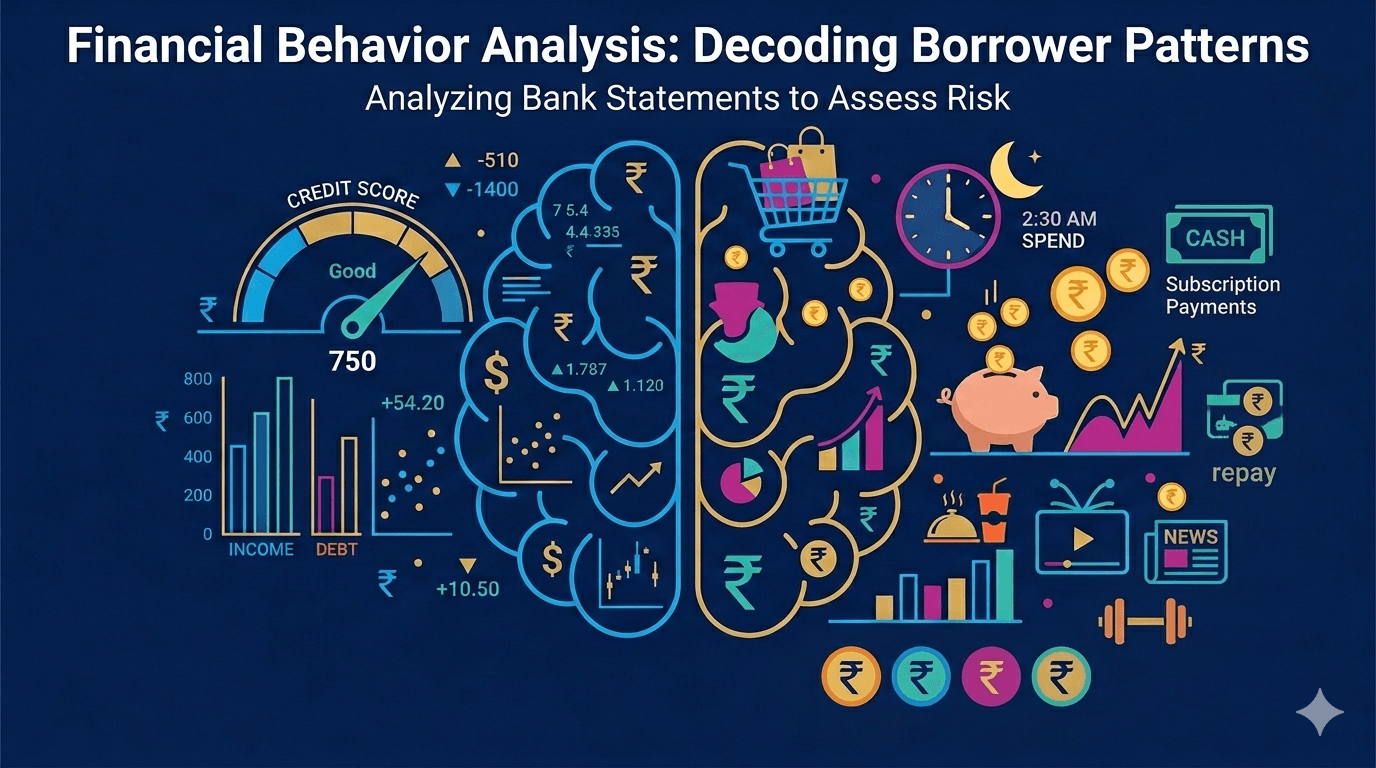
While traditional underwriting focuses on the “ability to pay” (income vs. debt), behavioral finance focuses on the “willingness to pay.” A bank statement analyser does more than just aggregate totals; it categorizes life choices. Every transaction is a digital footprint of a borrower’s priorities, biases, and habits.
For instance, two borrowers might earn the identical monthly salary of ₹1,00,000. Borrower A saves 10% immediately upon salary credit, while Borrower B spends 90% of their balance within the first week on discretionary lifestyle choices. Traditional metrics might see them as equals, but a deep-dive bank statement analysis reveals a stark difference in “Present Bias”—the tendency to value immediate rewards over long-term stability.
Related Reading: To better understand the specific language of these transactions, explore our Guide to Decoding Modern Bank Statement Terms, which explains how entries like NACH debits and sweep-out patterns signal borrower discipline.
Key Behavioral Indicators for Lenders
To accurately assess risk, lenders must look for specific behavioral patterns that correlate with credit performance:
1. The “Mental Accounting” Trap
Behavioral finance suggests people categorize money into “buckets.” Borrowers with strong financial discipline often maintain a “buffer” or a minimum threshold in their accounts. Conversely, borrowers who frequently hit near-zero balances—even if they never technically default—exhibit poor mental accounting. This “hand-to-mouth” behavior indicates a lack of an emergency fund, making them highly susceptible to external economic shocks.
2. Impulse Control and Discretionary Spending
High-frequency, low-value transactions at late hours (e.g., late-night food delivery or gaming subscriptions) can sometimes signal impulsive behavior. In a lending perspective, chronic impulsivity in spending often translates to impulsivity in debt acquisition. Financial behavior analysis helps identify these “lifestyle leaks” that might jeopardize future EMI repayments.
3. Hyperbolic Discounting and Over-Leveraging
Does the borrower frequently use “Buy Now, Pay Later” (BNPL) services or small-ticket instant loans? Frequent reliance on micro-credit for non-essential purchases reveals “Hyperbolic Discounting,” where the borrower prefers small immediate gains over the long-term cost of interest. For an NBFC, this is a red flag for a borrower who may eventually spiral into a debt trap.
Transforming Raw Data into Risk Intelligence
The challenge for lenders has always been the sheer volume of data. Manually reviewing six months of transactions to find these patterns is impossible at scale. This is where a sophisticated bank statement analyser becomes an indispensable tool for the modern credit team.
| Behavioral Signal | Interpretation for Lenders | Risk Level |
| Salary-to-Spend Velocity | How fast the income is exhausted post-credit. | Medium/High |
| Bounced Check History | Direct indicator of poor planning or liquidity stress. | High |
| Subscription Overload | Multiple recurring payments indicating high fixed-cost burdens. | Medium |
| ATM/Cash Dependency | High cash withdrawals can signal “off-book” expenses or lack of transparency. | Variable |
Lender’s Tip: Beyond individual psychology, business borrowers often display unique stress markers. Learn more about Decoding Risk in SME Lending to see how transaction velocity and counterparty analysis impact business creditworthiness.
Why NBFCs Must Embrace Behavioral Insights
For NBFCs catering to “thin-file” borrowers or those in the informal economy, bank statement analysis is often the only reliable source of truth. Since these borrowers may lack an extensive bureau history, their behavioral patterns become the primary proxy for risk.
- Identifying “Hidden” Stress: A borrower might have a clean credit bureau report but show increasing “inward return” charges or penalty fees in their bank statements. This is an early warning sign that the bureau hasn’t caught yet.
- Predicting Early Delinquency: By analyzing the “Net Surplus” trend over time, lenders can predict if a borrower’s disposable income is shrinking, allowing for proactive limit management or collection strategies.
Strategic Insight: For institutions looking to modernize their entire credit desk, our 2026 Guide to Bank Statement Analysis for NBFCs provides a roadmap for integrating these behavioral insights into a high-speed automated workflow.
Conclusion: The Future of Empathetic Lending
Integrating financial behavior analysis into your underwriting workflow isn’t just about rejecting more applications; it’s about approving the right ones. It allows lenders to identify “diamonds in the rough”—borrowers who might have a lower credit score due to lack of history but exhibit the disciplined financial habits of a low-risk client.
By utilizing a high-performance bank statement analysis tool, your institution can automate the detection of these subtle behavioral cues, ensuring that your lending decisions are backed by both hard data and human psychology. In the competitive world of fintech and NBFCs, the lender who understands the borrower’s mind, not just their balance, will ultimately win.
Is your credit engine equipped to decode borrower behavior? Discover how Pro Analyser can transform your underwriting with deep-tier financial insights.