The New Era of Credit Assessment for Lenders
In the fast-moving world of SME lending, relying only on a credit score is no longer enough. For underwriters and NBFCs, the real truth about a borrower’s health is hidden inside their bank transactions.
A deep bank statement analysis allows lenders to see the actual cash flow of a business in real-time. Instead of looking at old balance sheets, you get a clear view of how the business handles money today.
By understanding the daily rhythm of deposits and withdrawals, you can make better decisions. This helps in separating high-risk applicants from those who are truly “credit-ready.”
Spotting Revenue Trends with Transaction Velocity
Transaction velocity tells a lender how quickly money is moving through a business account. For an underwriter, a high velocity of small deposits often indicates a healthy, retail-based customer flow.
However, if money is leaving the account as soon as it hits, it shows a lack of liquidity. In SME lending, maintaining a “minimum average balance” is a key sign of a disciplined borrower.
Modern tools like a bank statement analyser help DSAs and lenders track these trends instantly. To see how automated insights improve the quality of your loan book, learn how Pro Analyser strengthens loan risk analysis to prevent defaults.
Detecting Financial Distress via NSF and Cheque Bounces
For any lender or NBFC, seeing “NSF” (Non-Sufficient Funds) or cheque bounce charges is a major warning. These entries suggest that the business owner is struggling with their daily working capital management.
Even if a business has high turnover, frequent bounces show that they are not monitoring their outflows. This operational messiness often leads to missed loan repayments in the future.
Using a bank statement analyzer ensures that no bounce or penalty goes unnoticed. It gives the credit team a clear “risk score” based on how many times the borrower failed to honor a payment.
Analysing Counterparty Risk and Business Stability
A business is only as strong as its customers. By looking at who is sending the money, underwriters can identify “concentration risk.”
If one single company provides 80% of the SME’s revenue, a delay in that one payment could crash the whole business. Lenders prefer borrowers who have a diverse range of buyers and steady inward remittances.
To get a 360-degree view, it is helpful to match bank data with tax filings. You can explore how bank statement + GSTR cross-verification helps in catching mismatches between reported sales and actual bank entries.
Uncovering Hidden Obligations: The Shadow of Daily ACH Draws
Many SMEs take “short-term credit” from multiple sources that don’t always appear on a credit report. These are often daily or weekly deductions via NACH or ACH transfers.
In SME lending, these hidden debts can ruin the borrower’s “debt service coverage ratio.” If half of their daily sales go toward paying off old high-interest loans, they won’t have enough to pay you back.
A thorough bank statement analysis identifies these recurring transfers immediately. This allows the underwriter to calculate the “true repayment capacity” before sanctioning a new limit.
Managing Seasonality: Using Longitudinal Data for Fair Assessment
Indian businesses are highly seasonal, festivals, harvests, and monsoons affect cash flow. A manual look at just three months of statements might give a lender a wrong impression of a business.
Lenders need to look at 6 to 12 months of data to see the “normalized” income. This helps in distinguishing between a temporary “slow month” and a permanent “business decline.”
Using an automated bank statement analyser allows you to see year-on-year growth trends. This ensures that cash flow assessment for lending is accurate and that you don’t reject good borrowers during their off-season.
The Strategic Advantage of Automated Bank Statement Analysis
For NBFCs and DSAs, speed is everything. If the underwriting process takes too long, the borrower will go to a competitor.
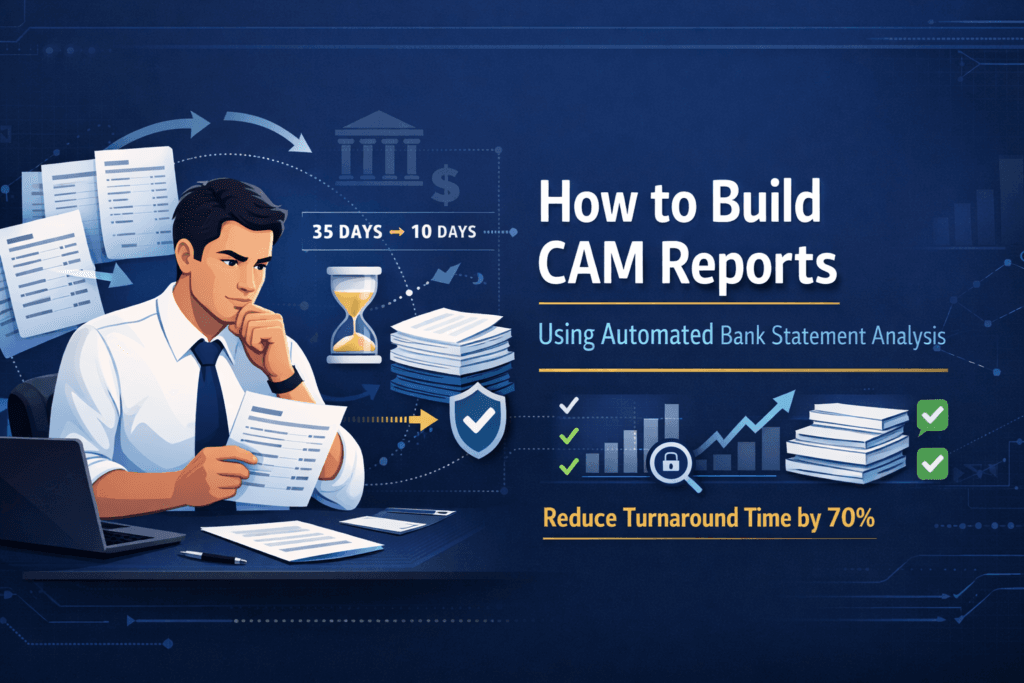
Moving from manual entry to a digital bank statement analyzer reduces the “turnaround time” (TAT) from days to minutes. It eliminates human errors and ensures every loan file is checked against the same high standards.
In the end, “reading between the lines” is about finding the balance between growth and risk. By using smart technology to analyze bank data, Indian lenders can build a safer, more profitable loan portfolio.