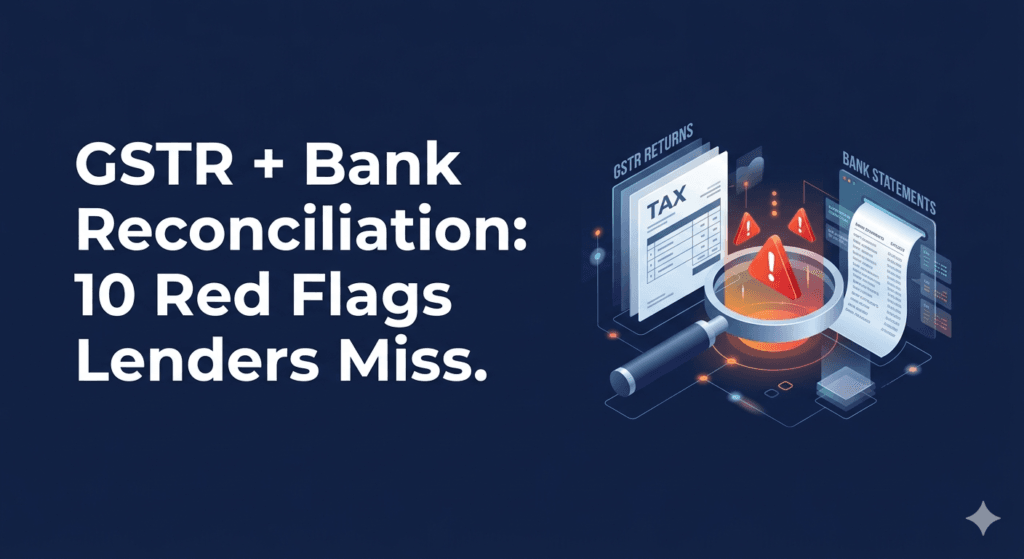
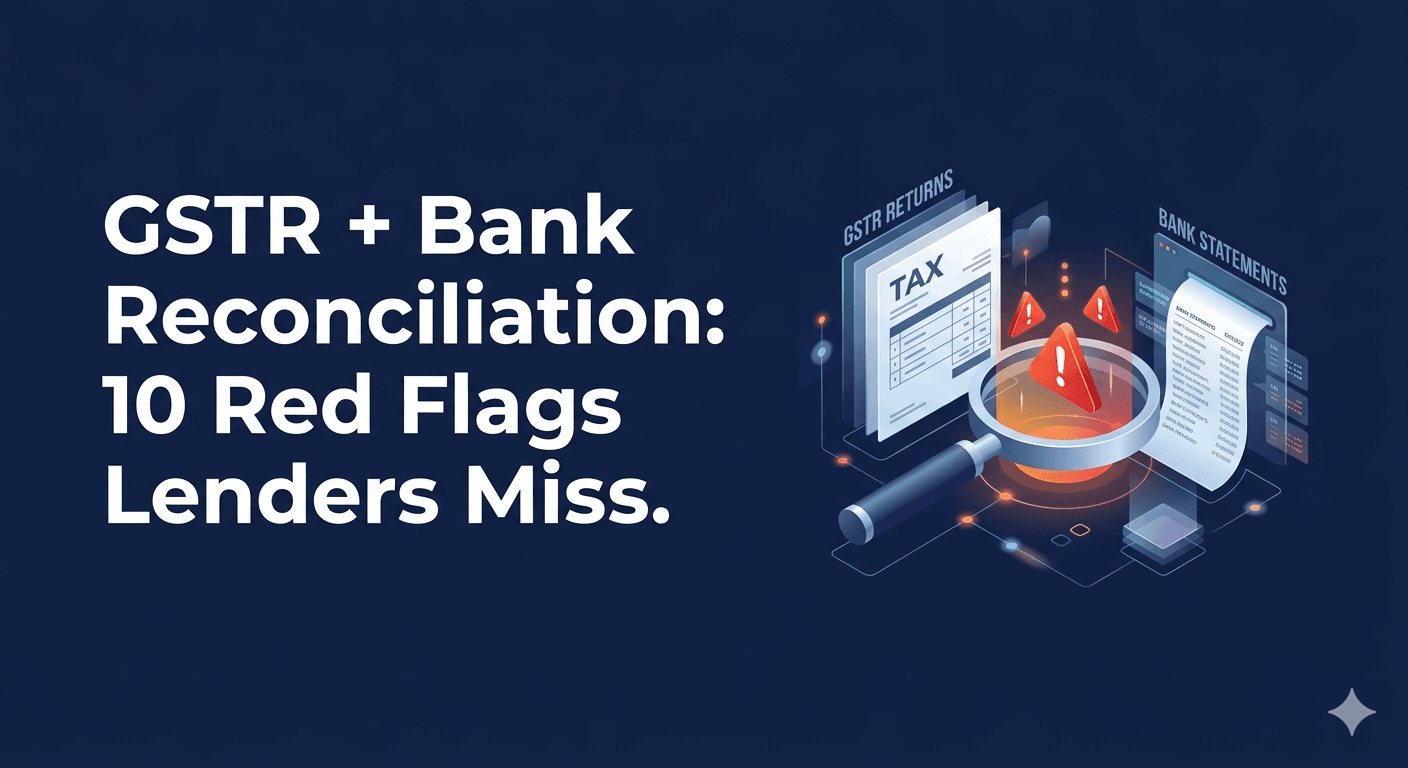
In modern MSME lending, verifying bank statements and GST returns in isolation is a recipe for high NPAs. A borrower might show a “healthy” ₹1 Crore turnover on paper, but if the cash flow doesn’t match, you aren’t looking at a thriving business you’re looking at a house of cards. GSTR bank reconciliation is the process of cross-referencing tax filings with actual banking data. When these two don’t align, it’s a clear signal of financial distress or reporting fraud.
Here are the 10 critical red flags and how Pro Analyser helps you automate their detection.
1. The “Ghost” Inflow Gap (GSTR-1 > Bank Credits)
The Flag: Declared GSTR-1 sales are significantly higher than the total business credits in the bank statement.
- The Reality: Borrowers often inflate sales figures to qualify for higher loan limits.
- Example: A textile trader reports ₹80 Lakh in monthly sales in GSTR-1 to show scale, but his bank statement analysis reveals only ₹45 Lakh in actual credits. The remaining ₹35 Lakh is likely “paper turnover” created via fake invoices.
2. ITC Claims Without Outward Payments
The Flag: High Input Tax Credit (ITC) claimed in GSTR-3B, but no corresponding outward payments to those suppliers in the bank account.
- The Reality: This suggests “buying” ITC from shell companies to reduce tax liability without actually purchasing goods.
- Example: A construction firm claims ₹10 Lakh in ITC (implying ₹55 Lakh+ in purchases), but the bank statement shows zero payments to the vendors listed in their purchase register.
3. Circular Trading & Round-Tripping
The Flag: Money leaves the account and returns in almost identical, rounded amounts from a related entity within a short window.
- The Reality: Classic “turnover padding.” By moving the same ₹5 Lakh between three sister concerns, a business can falsely claim ₹15 Lakh in monthly turnover.
- Example: On the 10th of the month, the borrower pays ₹2,00,000 to “Entity B.” On the 11th, “Entity B” pays back ₹1,98,500 as “Sales Inward.” A manual gst analysis might miss this, but an automated bank statement analyser flags it instantly.
4. “Too Perfect” Rounded Figures
The Flag: GSTR-1 figures that are perfectly rounded (e.g., exactly ₹5,00,000 every month) while bank statements show messy, fluctuating transactions.
- The Reality: Real-world commerce involves decimals and odd numbers. “Too perfect” GST data is usually manufactured by an accountant just before a loan application.
- Example: A borrower’s GST portal shows sales of exactly ₹10,00,000.00 for three consecutive months. Meanwhile, their bank account shows 400 small transactions totaling ₹8,42,105. The mismatch indicates the GST filing is a “plug number” to satisfy the bank.
5. Nil Returns Amidst High Bank Activity
The Flag: The borrower files “Nil” GSTR-3B returns, but the bank statement shows active business credits and salary payments.
- The Reality: This is tax evasion. While the business is active, they are hiding sales from the government. This creates a massive regulatory risk where the GST department could freeze the bank account.
- Example: A restaurant shows ₹15 Lakh in monthly UPI/Card swipes in their bank statement but files a “Nil” GSTR-3B claiming zero taxable sales for that period.
6. Sudden Window Dressing Before Application
The Flag: A massive spike in both GSTR turnover and bank deposits in the 2-3 months immediately preceding the loan application.
- The Reality: Borrowers often take short-term “bridge” loans from the unorganized sector to beef up their profile, which they repay immediately after your loan is disbursed.
- Example: A business with an average turnover of ₹5 Lakh for 9 months suddenly shows ₹25 Lakh in turnover for the 2 months before applying for a ₹50 Lakh loan.
7. Tax-to-Turnover Mathematical Mismatch
The Flag: The tax paid in GSTR-3B doesn’t align with the “Sales Inward” in the bank account based on the industry-standard GST rate.
-
The Reality: If the math doesn’t add up (
$$Sales \times GST \text{ rate} \neq \text{Tax Paid}$$
), the borrower is misreporting to one of the two parties. - Example: A software firm (18% GST) has ₹100 in bank credits, but their GSTR-3B shows only ₹8 in tax paid. They should have paid ₹18. This ₹10 gap is a major audit risk.
8. High ITC Reversals (The 180-Day Rule)
The Flag: Frequent ITC reversals in GST filings due to non-payment to suppliers within 180 days.
- The Reality: This is a huge sign of liquidity stress. If they can’t pay their suppliers on time, they are unlikely to pay your EMI.
- Example: A manufacturing unit has ₹12 Lakh in “ITC Reversal” in their annual GSTR-9, indicating they failed to pay their raw material suppliers for over 6 months.
9. Weekend & Late-Night “Business” Transactions
The Flag: Large GST-linked payments or transfers occurring at 3 AM or on Sundays/Public Holidays.
- The Reality: Genuine B2B payments usually follow banking hours. Out-of-hours spikes often point to manual manipulation of digital records when “fewer eyes” are on the system.
- Example: A wholesaler’s bank statement shows five transfers of ₹2 Lakh each made at 2:30 AM on a Sunday highly unusual for a business that operates from 10 AM to 7 PM.
10. The “Single Vendor” Concentration
The Flag: 90% of the ITC in GSTR-2B comes from a single vendor, but the bank statement shows no operational expenses (like rent or electricity) for a business of that scale.
- The Reality: This indicates a “pass-through” entity or a shell company setup where no real value addition is happening.
- Example: A trading firm claims to do ₹2 Crore in sales but their bank statement shows zero payments for rent, staff salaries, or electricity. This is a classic “office-on-paper” fraud.
Why Manual GSTR Bank Reconciliation is a Growth Killer
In the high-volume world of MSME lending, performing a manual GSTR bank reconciliation is no longer a viable strategy. When credit officers manually compare GST portal screenshots against PDF bank statements, they aren’t just losing time, they are prone to “fatigue blindness.”
Small discrepancies in tax-to-credit ratios that signal deep financial distress often go unnoticed in a manual workflow. Transitioning to an automated bank statement analyser allows your team to catch these subtle patterns at scale, ensuring that every loan approved is backed by verified, cross-referenced data.
How Pro Analyser Solves the Reconciliation Nightmare
Manual GSTR bank reconciliation can take a credit manager up to 6 hours per file. Pro Analyser reduces this to under 3 minutes through:
- Automated Cross-Verification: It pulls data from GST portals and bank PDFs simultaneously, highlighting every mismatch in a single dashboard.
- Fraud Detection: It identifies tampered PDFs and “Circular Trading” loops that are invisible to the human eye. Learn more in our Bank Statement Fraud Detection Guide.
- Industry Benchmarking: It compares the borrower’s cash-to-tax ratio against industry norms to detect under-reporting.
- Instant Scoring: It generates a “Financial Health Score” based on filing consistency and cash flow stability. Read about how this reduces loan TAT and improves accuracy.
Future-Proofing Your Credit Desk with Automation
As we move further into 2026, the complexity of financial fraud continues to evolve. Relying on a standalone bank statement analyser is a great first step, but the real power lies in integrated data.
By performing a real-time GSTR bank reconciliation, lenders can verify the “Document DNA” of a business from two entirely different regulatory perspectives. This dual-layer verification is the most effective way to eliminate the risk of window dressing and ensure that the MSME’s reported growth is reflected in their actual liquid cash flow.
Conclusion
By leveraging bank statement analyser and GSTR analyser through Pro Analyser, lenders can move from “guessing” to “knowing.” Automated tools don’t just save time; they protect your capital from sophisticated fraud.
Explore more on how to secure your lending process: