| Quick Takeaways: Secure Your Lending Workflow |
| The Threat: Banking frauds in India surged to over 100$ billion in FY2024 (RBI), making manipulated Bank Statement PDF the #1 threat in digital lending. |
| The Solution: A Bank Statement Analysis API automates PDF validation, catching fraud by analyzing metadata, transaction patterns, and using AI for tampering detection. |
| The Benefit: Prevents Non-Performing Assets (NPAs), ensures regulatory compliance (PMLA), and drives profitability by accelerating genuine loan approvals. |
The Critical Need for Bank Statement PDF Validation in Digital Lending
Today’s loan applications rarely arrive as a single, simple document. Borrowers typically submit a stack of digital files – multiple Bank Statement PDFs, GST returns, invoices, and ID proofs. While these documents appear to offer a complete financial picture, their authenticity is the biggest risk.
Lenders rely on financial analysis software to extract data and evaluate creditworthiness. But the uncomfortable truth is that not every PDF tells the truth.
Fraudsters are now leveraging free editing tools to manipulate Bank Statement PDFs – inflating business revenue, hiding existing liabilities, or even creating fake accounts. A single falsified file can immediately lead to:
- A toxic loan that quickly becomes a Non-Performing Asset (NPA).
- Costly regulatory scrutiny and penalties under acts like PMLA.
- Long-term reputational damage to the NBFC or bank.
With the value of banking frauds in India surging past 100$ billion in FY2024 (RBI data), validating Bank Statement PDFs before any approval is no longer a best practice, it is an essential requirement for survival in Digital Lending Fraud prevention.
What is a Bank Statement Analyser?
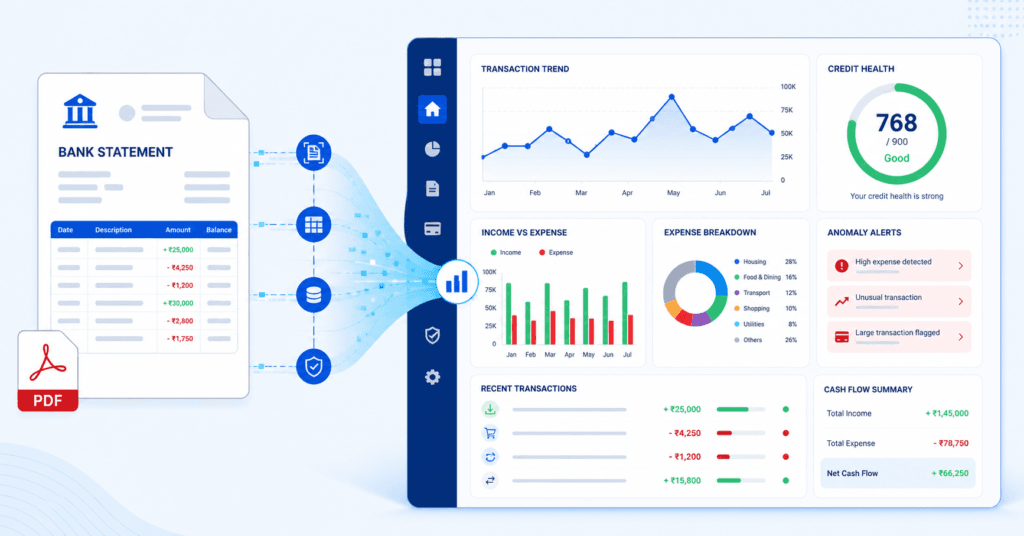
A Bank Statement Analyser is an automated, secure software solution that lenders integrate directly into their digital lending workflow. Instead of relying on slow, error-prone manual checks, the Analyser provides instantaneous, deep-level Document Tampering Detection and actionable insights.
The Analyser transforms the complex Loan Verification Process by achieving three core objectives:
- Data Extraction: Extracts structured, usable data from unstructured Bank Statement PDFs and related documents.
- Authenticity Verification: Instantly verifies the authenticity of each file in seconds using multi-layer checks.
- Anomaly Flagging: Highlights suspicious patterns and anomalies for underwriters, automating the identification of high-risk cases.
This level of automation is critical for Credit Underwriting Automation and ensures that lenders maintain scale without compromising security, making the Bank Statement Analysis Software a fundamental tool for modern risk management.
For more examples of how this helps catch falsified documents, see our post on Prevent Loan Fraud with Smart Bank Statement Analyser Tool.
How Bank Statement PDF Validation Works: The Four-Layer Check
Modern APIs enforce a rigorous, multi-layered approach to ensure lenders process only authentic files, significantly reducing the risk of synthetic and document fraud.
1. The Secure Upload and Digital Scan
When a borrower submits Bank Statement PDFs (along with GST returns or credit bureau reports), the system first runs an initial validation check. Every document is securely stored in the cloud and subjected to a deep digital fingerprint comparison against a trusted library of authentic document formats.
2. Checking the Document DNA (Metadata Analysis)
Every PDF file carries a set of hidden, non-visual details—its metadata. This is the first critical layer of Document Tampering Detection. An authenticating API checks metadata points such as:
- Creator/Producer software and version.
- Original creation and modification timestamps.
- Fonts, text encoding, and file size consistency.
Any significant mismatch between the file’s recorded DNA and that of a truly authentic bank-issued statement is a clear signal of possible manipulation or a synthetic document.
3. Generating Authenticity Outcomes
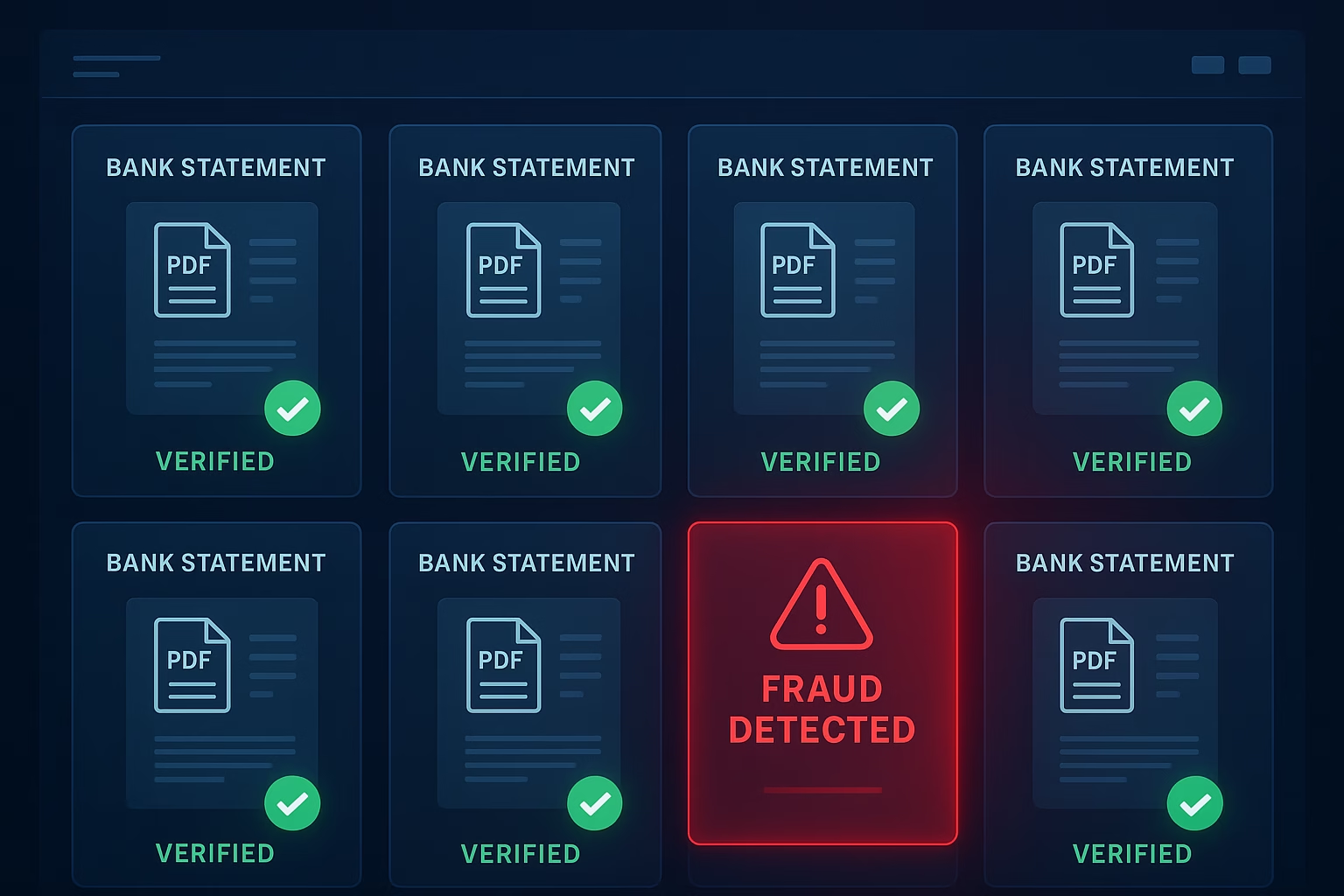
Within seconds, the system provides a clear, actionable outcome for each uploaded Bank Statement PDF on the underwriting dashboard. These four outcomes empower lenders to make swift, compliant decisions:
- Original: No tampering detected; the file is verified as authentic.
- Fraud: Confirmed manipulation detected; the document is flagged as fraudulent.
- Review: Mixed or conflicting signals; requires mandatory manual verification by an underwriter.
- Unknown: Insufficient data or an unusual format; additional proof is requested from the applicant.
4. Spotting Suspicious Transaction Patterns
Bank Statement PDF Validation doesn’t stop at file metadata. Advanced Bank Statement Analyser Software also uses rules-based engines and heuristics to analyze the actual transaction data inside the statement for behavioral red flags.
Common indicators of borrowers attempting to game the system (synthetic entries) include:
- RTGS payments under ₹2 lakhs (often used to bypass threshold scrutiny).
- Round-figure tax payments or recurring deposits (indicating manually synthesized entries).
- Salary credits followed by immediate, large-figure withdrawals (potential “parking” of funds).
- A discrepancy between the actual closing balance and the mathematically computed balance.
- High-velocity, same-day debit and credit transactions with the same counterparty.
Some of these match the warning signs we explore in “5 Red Flags to Watch for in Bank Statements Before Approving a Loan“
Role of AI & ML in Detecting Synthetic Fraud
To combat increasingly sophisticated fraudsters, the best Bank Statement Analysis API solutions go beyond simple metadata checks and incorporate advanced Artificial Intelligence (AI) and Machine Learning (ML).
Signature and Visual Tampering
AI models are trained on millions of authentic and fraudulent documents to detect minute visual anomalies that are invisible to the human eye, such as:
- Font Inconsistency: Identifying a change in font weight, size, or kerning within the same document.
- Pixel-Level Forgery: Detecting digital artifacts or ‘smudges’ around key numbers or names where editing software was used to alter data.
Identifying Synthetic Entries
ML models are exceptionally good at finding anomalies in time-series data. They analyse the pattern of transactions over 6-12 months to create a ‘normal’ borrower profile. When an application presents a sudden, non-organic shift, such as a huge, one-time influx of cash just before the loan application (often used to fake eligibility). the model flags it as a high-risk synthetic entry, preventing Digital Lending Fraud.
Use Cases Across Lending Types
The value of authenticating Bank Statement PDFs is proven across the lending landscape:
| Lending Segment | The Fraud Risk | How Validation Helps (Experience) |
| MSME/Business Loans | Inflated revenue to meet turnover criteria; hidden liabilities in undisclosed accounts. | Instantly verifies GST returns against bank credits, catching revenue manipulation at the source. |
| Personal Loans | Fake salary slips or “parked” funds to show a high average monthly balance. | Document Tampering Detection spots the digital artifacts of an edited salary credit and checks the velocity of fund movement. |
| NBFCs & FinTechs | High application volume leading to systemic risk and rising NPAs. | Provides instant, scalable decisions, automating the bulk of low-risk applications while flagging high-risk ones for manual review. |
Why Validating Bank Statement PDFs Matters Now
Adopting an automated solution is a strategic necessity that delivers competitive advantages far beyond simple security.
1. Prevent Loan Fraud and NPAs
Fraudulent borrowers intentionally push lenders into issuing toxic loans. Early fraud detection—before disbursement—stops revenue leakage and directly prevents the creation of Non-Performing Assets (NPAs), protecting the balance sheet.
2. Ensure Strict Compliance
Regulatory bodies, including the RBI, demand strict due diligence and robust Loan Verification Processes. Automated Bank Statement PDF Validation ensures compliance with stringent PMLA (Prevention of Money Laundering Act) and the new Digital Lending Guidelines, helping lenders avoid severe penalties and public censure.
3. Protect and Strengthen Your Reputation
A single, high-profile case of fraud can damage public trust and severely affect the brand image of a financial institution. Validation safeguards your reputation by demonstrating a commitment to ethical, secure lending.
4. Drive Operational Efficiency and Profitability
By shifting from manual reviews to automated, instant validation, lenders gain:
- Scalability: Process thousands of documents simultaneously.
- Error Reduction: Eliminate human oversight and ensure consistent decisions.
- Faster Decisions: Reduce the loan approval cycle from days to minutes, significantly improving the customer experience and driving profitability.
This speed and scalability are showcased in our detailed post on ‘Bank Statement Analysis Software for Fast & Accurate Insights.
The Key Takeaway for Lenders
Fraudulent and manipulated Bank Statement PDFs represent one of the fastest-growing threats in digital lending today, with the cost of inaction measured in billions of rupees. Manual checks and basic scrutiny are no longer a viable defense.
By integrating an advanced Bank Statement Analysis API, modern lenders can:
- Instantly validate the authenticity of every PDF.
- Detects subtle tampering attempts using AI and metadata analysis.
- Confidently automate the underwriting of genuine loans.
Pro Analyser provides lenders with one of the most advanced Bank Statement Analyser solutions available. From deep authenticity checks to transaction-level insights, our platform simplifies Loan Verification Process and accelerates lending decisions with unparalleled accuracy.
Integrate our Bank Statement Analysis API into your workflow to automate document checks, prevent fraud, and accelerate lending decisions. Ready to protect your digital lending workflow with certified Bank Statement PDF Validation? Try Pro Analyser Free Trial Now.